At EuroCucina 2026, the kitchen emerged as both a technological frontier and a canvas for architectural expression. Our highlights from the biannual showcase of kitchen products suggest a movement toward spaces that are both ingeniously functional and aesthetically refined, with brands pushing boundaries through seamless integration, sculptural forms and modular layouts. Rather than simply adding new features, designers are also rethinking how kitchens relate to the rest of the home, creating environments that adapt to evolving lifestyles and invite creative expression. Below, we round up four products that stood out for their design as much as performance.
1
Expressive Series by Gaggenau
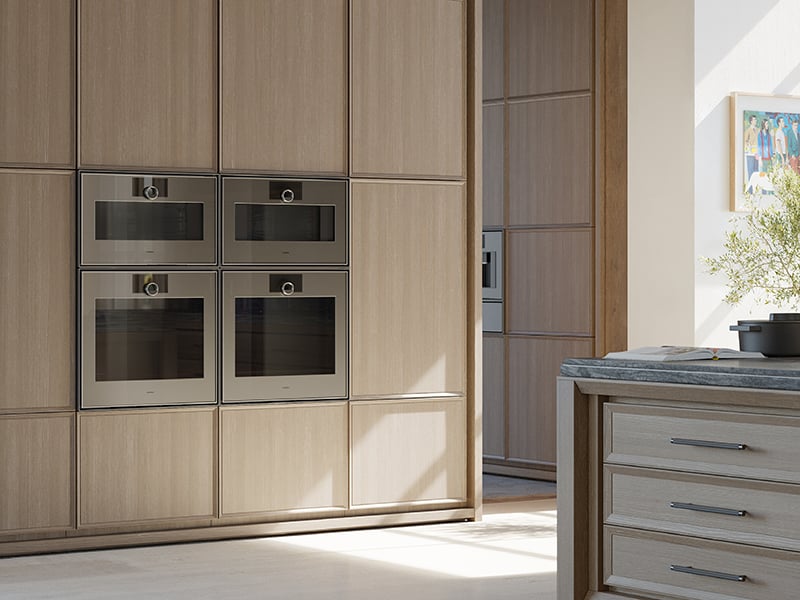
It seems appliances are becoming more high-tech with every passing year, with WiFi connectivity now a given and AI-assisted cooking not far out of reach. With the introduction of such extensive features, the challenge then becomes to design a user interface whose simplicity belies this complexity. That is exactly what has done with the — the brand’s first completely new launch in almost 20 years, whose innovative design was a decade in the making.

Drawing from the graphic simplicity of the Bauhaus movement, the oven is defined by its architectural, dual steel frame, which surrounds the cooking space, and a circular dial set into the interactive touchpad. This ring is both a functional control and a visual indicator to track cooking progress, with lighting that glows in concert with the timer or as a meal nears the set core temperature. On the touchpad (or the accompanying Home Connect app), users can pre-set their favourite settings, so they are always at the ready. For Gaggenau, technology is not a gimmick nor an add-on; it is integral to the cooking experience.
2
Flair by Scavolini

As the boundaries between cooking, living and entertaining continue to blur, kitchen design is increasingly shaping the broader domestic interior. This was the impetus for ’s launch, , which is designed to translate seamlessly across nearly every room in the house, embracing the “total home look.” Characterized by fluid curvature and a palette of soft neutrals, the modular series includes base units, tall units, wall units and open shelving in convex and concave variations, designed to be mixed and matched.

The resulting flexibility means Flair lends itself to everything from kitchen cabinetry to media units and bathroom vanities. That adaptability is particularly compelling in the kitchen, where cabinetry increasingly serves both practical and social functions. The concave end unit, for instance, lends the island a more sculptural silhouette, carving out space for a built-in breakfast bar. Even in its most functional applications, Flair brings a distinctly architectural sensibility to the everyday.
3
Minimal Style by Fisher & Paykel

’s launches at EuroCucina stood out for their ability to blend in. Take the award-winning Column refrigeration series (including a stunning wine cabinet), which disappears into cabinetry for a seamless look that gives designers complete creative control — offering support for custom surface materials, precise control of reveals and gap alignment, hinge configurations and adjustable toe-kick heights. Inside, Variable Temperature Zone technology ensures food is stored at the optimal temperature to retain freshness, texture and nutrients.

The brand’s next-generation oven is also conceived to sit flush with cabinetry, with gaps as small as 2mm between appliance and joinery. Available in 30-inch or 60-inch versions, in black or grey glass, the minimal design is a natural fit for contemporary kitchens. And it’s not short of high-tech features either: voice activation allows for hands-free cooking when you have multiple meals on the go. Complementing the ovens, Fisher & Paykel’s modular induction cooktops are configured through a single interface to suit individual cooking styles and spatial layouts. When you’re done cooking, clean-up is a breeze with the new integrated DishDrawer Dishwasher — which now recovers and reuses energy during the wash and dry process to reduce energy consumption by up to 50 percent.
4
Kora by Arclinea

’s latest collaboration with Antonio Citterio, shown at its Via Durini flagship, was another Milan Design Week standout. Dubbed Kora, the kitchen island is defined by its curved edges, considered proportions and material continuity — making it both a sculptural focal point and a hub for gathering. “The name itself, Kora, evokes an idea that has accompanied my work for some time and that I also encountered in certain theoretical reflections on architecture contained in the book Topos – Khora e Architettura, written by Attilio Marcolli in 1969: the idea that form emerges from a generative space of possibilities. In this sense, Kora arises from a reflection on how the kitchen is used and how people live and move around it,” Citterio explains.

Enhancing the minimal design, the handles are recessed directly into the marble, celebrating both craftsmanship and the depth of the material. The collection is also available in wood, PVD and polished steel options for ultimate versatility. Alongside the island, Citterio designed three organically-shaped tables — Folia, Vesper and Orbita — that extend the kitchen space for a cohesive composition.
For more , visit our Spec Sheets section.
The post appeared first on .
Related Posts