
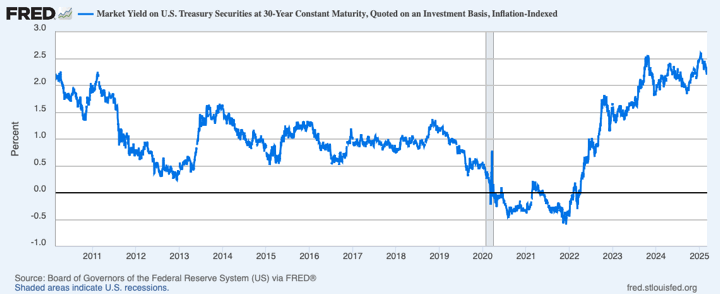
If you are a DIY investor (or professional financial planner) that is looking to geek out on the intricacies of the tax treatment for holding Treasury Inflation-Protected Securities (TIPS), check out the new paper by Edward F. McQuarrie. I’ve been building a ladder of individual TIPS for many years, and have been extending it and filling in gaps during the recent period when long-term real rates went up to ~2.6%. Here is a chart of historical 30-year real rates (TIPS pay this much above inflation):
The paper focuses specifically on TIPS ladders, where you hold individual TIPS with staggered maturities such that when one matures each year, it creates a level, inflation-adjusted stream of annual income. The primary unique feature of this ladder is that it is guaranteed to adjust for inflation (as measured by CPI), even if it is higher than expected. Regular, nominal bonds don’t provide this protection. Of course, if inflation is lower than expected, then those nominal bonds will outperform TIPS.
The paper itself is very detailed and took a few readings to fully comprehend it all, but I definitely learned some new wrinkles. However, the overall conclusions are still useful to keep in mind if you hold TIPS. The question is, where is the preferred place to locate TIPS? In a regular taxable brokerage account? In a tax-deferred account like a pre-tax IRA or 401(k)? In a Roth IRA or 401k(k)?
Here are my takeaways, in my own words:
Individual, longer-term TIPS should be avoided if possible in a regular taxable brokerage account. This is primary due to the unique taxation of TIPS and the “phantom income” they make you pay upfront if there is inflation. You can look up “TIPS phantom income” for more details elsewhere, but the bottom line is that it’s hurts you upfront and you don’t catch up. Things only get worse at higher income tax rates, and higher inflation rates. It’s also just an extra annoyance at tax filing time.
The overall preferred location for TIPS is a Tax-Deferred Account (TDA). In other words, a pre-tax 401(K) or a Traditional pre-tax IRA where the tax is deferred but you pay taxes at ordinary income rates upon withdrawal.
It’s better to put stocks and REITs in a Roth account, so also not TIPS ideally. Roth accounts are great overall, but it’s best to take advantage of them by putting stocks and REITs inside as there is not as much added benefit for TIPS (or bonds in general).
The paper also discusses the wrinkles from state income tax and RMDs, but they don’t change the overall recommendation.
Here is a direct quote from the paper:
It follows that if the client has a more aggressive asset allocation, perhaps 2:1 stocks versus fixed income, with three accounts of roughly equal size, then stocks should first fill the Roth and then fill taxable. A TDA is always the best location among the three account types for a bond ladder, especially TIPS. Distributions are required from TDAs, and bond ladders produce distributions. Bond income is taxed as ordinary income, and distribution from TDAs are taxed as ordinary income. Characteristics of the bond asset and the TDA account are aligned.
The paper also states “The paper does not consider the best location for TIPS bonds or bond funds during the accumulation phase.” I would then add myself that if you do really want to own TIPS in a taxable account, you should consider a low-cost index ETF which is really sort of a ladder of TIPS than replenishes on its own with a roughly constant average maturity. For short-term TIPS, there is the Vanguard Short-Term Inflation-Protected Securities ETF with an average maturity of ~2.5 years. For a longer-term, there is the Schwab U.S. TIPS ETF with an average maturity of ~7 years. TIPS ETFs don’t expose you to the phantom income effect.
Again, this paper offered some additional insight for those so inclined. I hold all my individual direct TIPS in a pre-tax Solo 401(k), so I am following the advice. I am not building a strict ladder, so if I ran out of room in tax-deferred accounts, I would hold a TIPS ETF in a taxable account.
Photo by on
Related Posts