When marks its milestones, it doesn’t merely look back; the Italian marque sketches the future. In honor of its 76-year legacy since the 1949 win at 24 Hours of Le Mans with the 166 MM Barchetta, the company has introduced the Ferrari F76: a purely digital hypercar existing solely as an , ushering in a new era of automotive design and ownership.
Ferrari describes the F76 as the first-ever “digital hypercar,” built not for asphalt but for the blockchain. The project was conceived by Ferrari’s Styling Center under Flavio Manzoni as a legitimate design exercise, rather than a mere digital novelty. The choice of the number 76 commemorates Ferrari’s endurance racing heritage while signaling a bold digital pivot.
Designer:
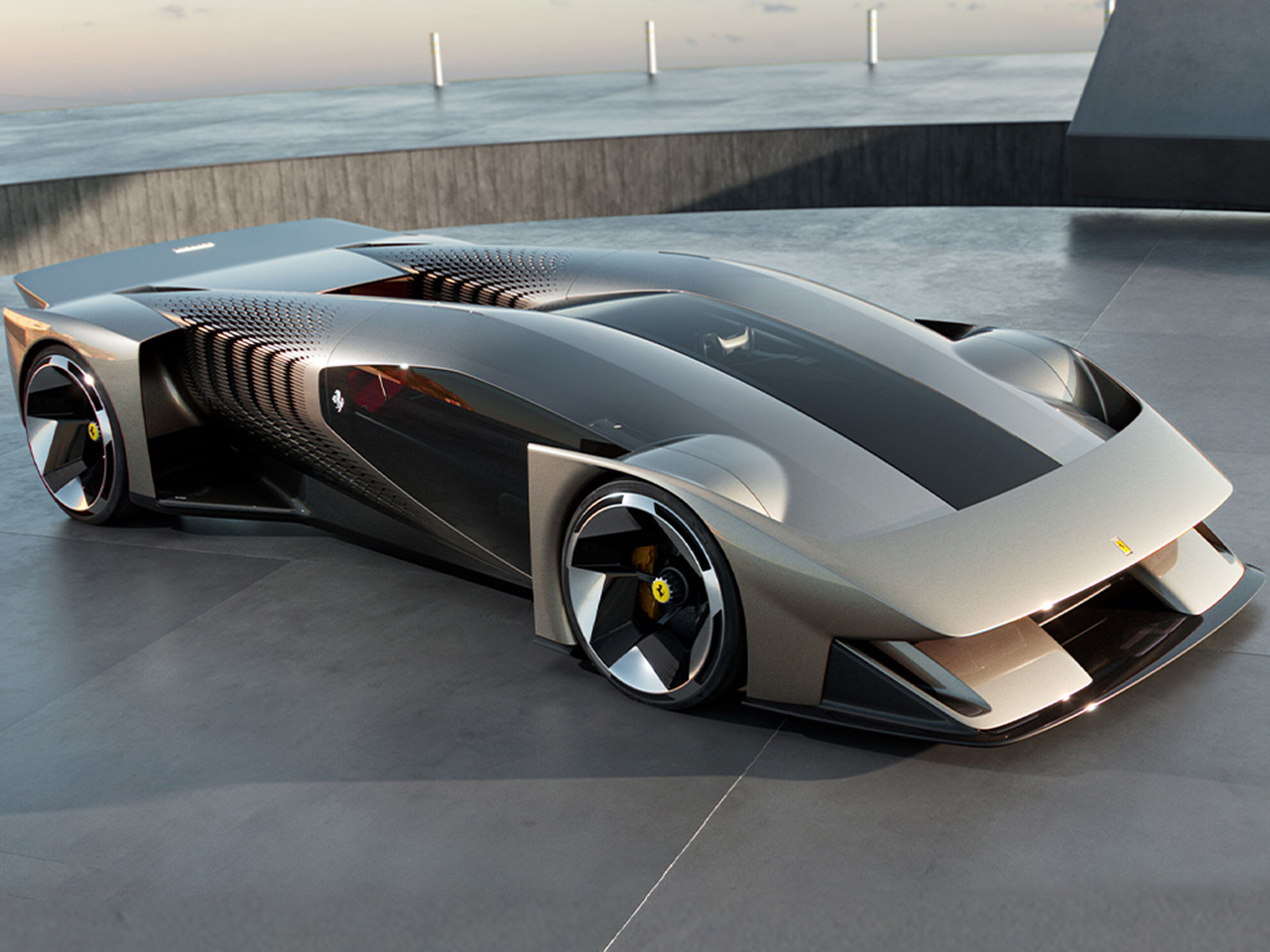

The F76 breaks conventional design constraints by embracing the possibilities of digital space. Its double-fuselage layout separates driver and passenger into two distinct cells, flanking a central channel that transforms the entire body into a giant wing, something entirely unfeasible under road-car regulations. The front features retractable headlights tucked beneath a floating band, vertical side cuts echoing the forthcoming F80 hypercar, and a rear section where four characteristic Ferrari taillights are integrated into a wing-bridge structure.

Ferrari employed generative algorithms and parametric design to optimize the F76’s bodywork for aerodynamics, cooling and ground-effect performance, an approach that Chevrolet might call “physics by code”. Inside the two cockpits, drive-by-wire technology synchronizes steering and pedals so driver and passenger receive feedback in unison, even though in the digital realm “feedback” is to the senses rather than the seat of the pants.

Availability is strictly limited to invitation-only membership in Ferrari’s “Hyperclub.” Each owner selects livery, wheels and interior trim during a three-year drop schedule, then receives a locked-down digital file: a unique NFT that can be held, sold, or displayed in a virtual garage. Pricing remains undisclosed and no real-world counterpart is being built. This is creation at the speed of light, not rubber on tarmac.

With the F76, Ferrari isn’t just tapping into the NFT trend; it’s staking its claim on digital metamorphosis. The project serves as a concept vehicle for design ideas that could eventually filter into road-going models, even though today the F76 is confined to the virtual realm. For enthusiasts of car culture and digital innovation alike, it raises the question: if a only exists in code, how real is the experience, and how far will that novelty travel into the physical world?

If you’re intrigued by the intersection of hypercar design, blockchain and digital exclusivity, keep an eye on how the F76 evolves—and whether its design DNA migrates into tangible Ferrari models. Consider this your invitation to explore what the future of automotive expression might look like. We also cannot count out the appearance of this beautiful hypercar in game franchises like Forza Horizon or Gran Turismo.


The post first appeared on .
Related Posts