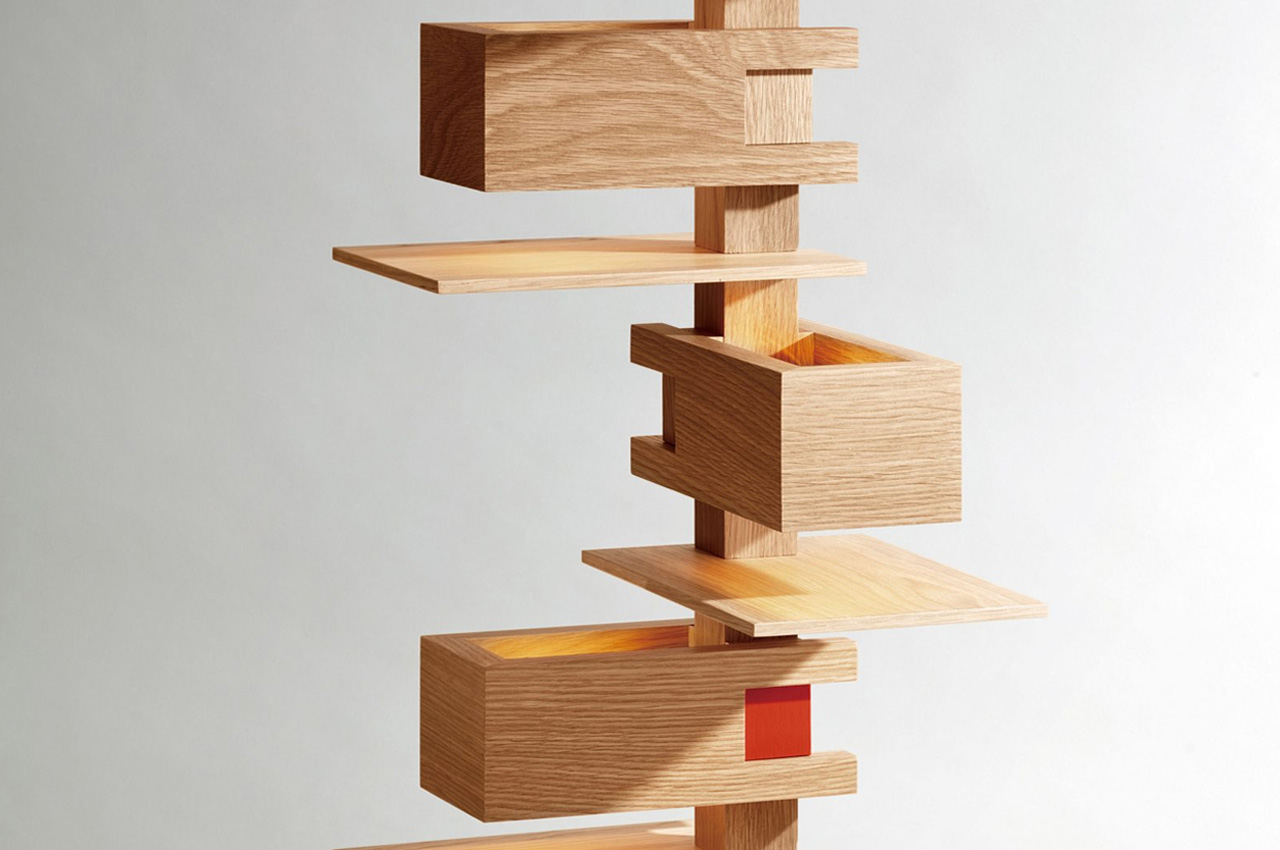
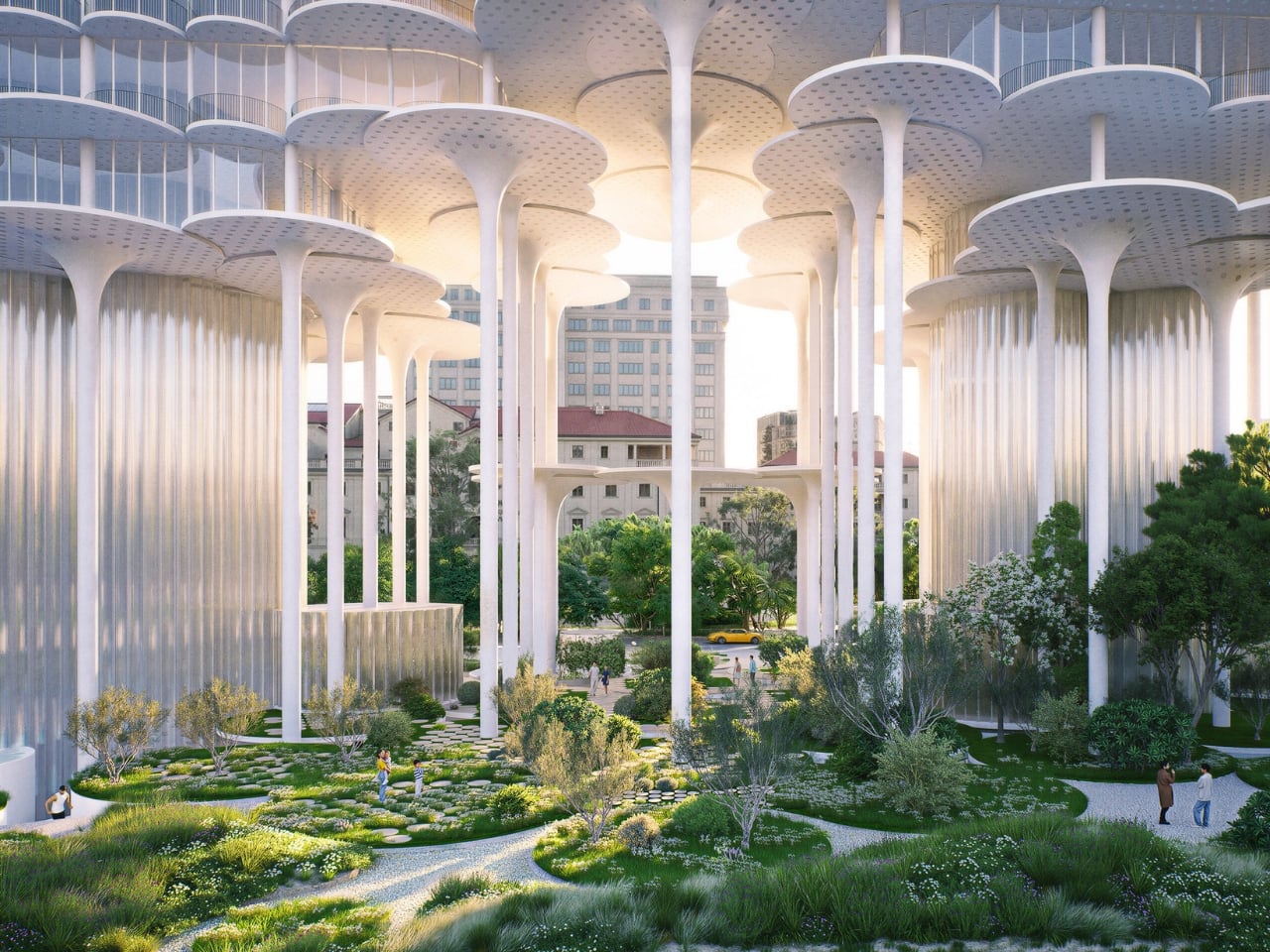
is always an exercise in abundance, but certain threads stood out across the 2026 product releases: becoming more architectural, outdoor furniture moving closer to the language of interiors and materials being asked to carry deeper stories of time, use and craft.
Across bathroom, , and design, the strongest launches were not simply new objects, but new ways of thinking about how products support daily life. From Laufen’s subtle approach to ageing in place to Talenti’s boundaryless indoor-outdoor vision, the following brands offered some of the most considered releases of the season.
Talenti
used Milan Design Week 2026 to mark a significant evolution in the brand’s identity. Founded as an outdoor furniture company, Talenti is now expanding into interiors through Talenti Home, positioning indoor and outdoor not as separate categories but as parts of a continuous living environment.
At its Via Manzoni flagship store, the brand presented a restyled space designed to dissolve boundaries between exterior and interior. The new brought together greenery, boiserie, drapery, texture and scenographic depth, reflecting Talenti’s shift towards a total living system.
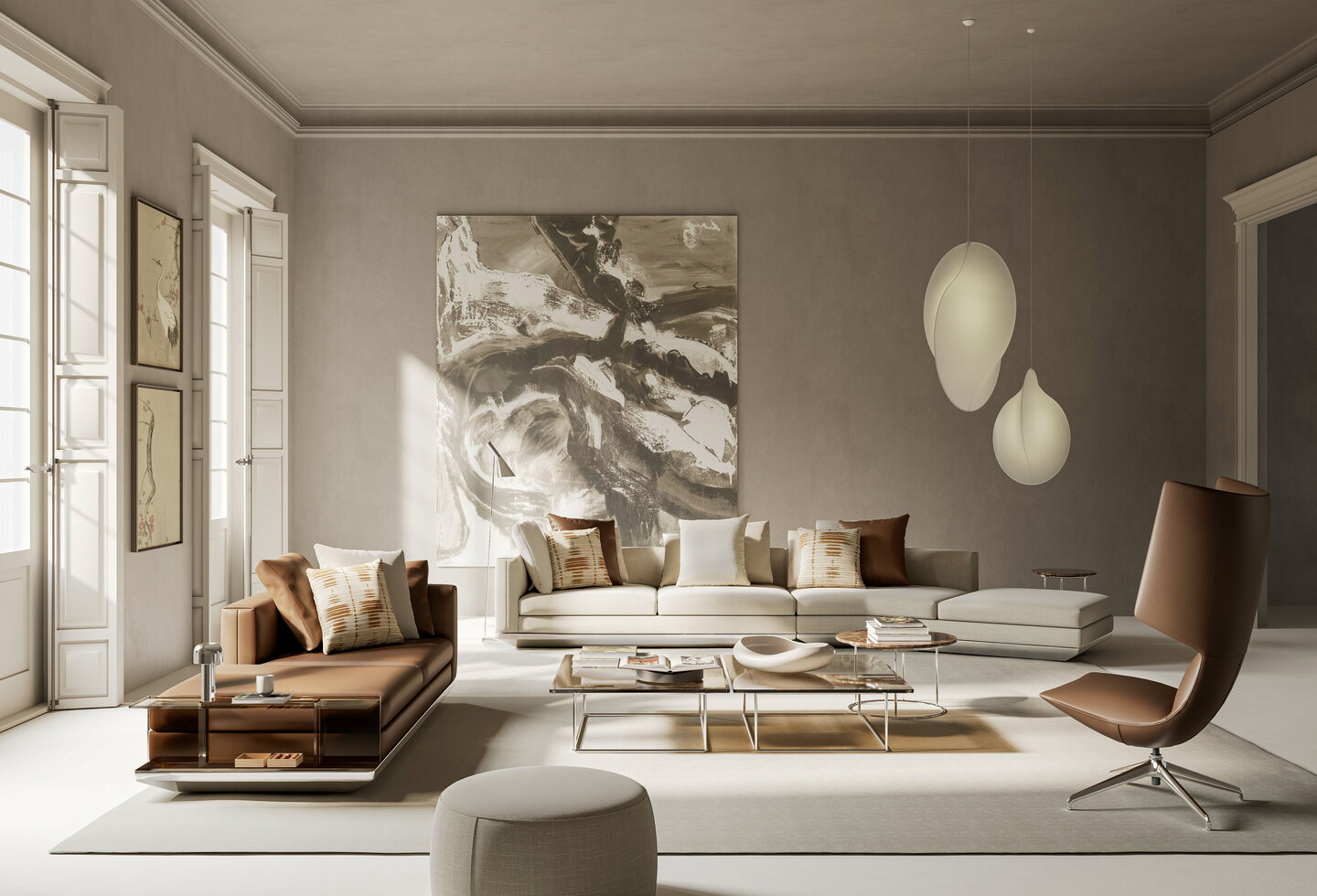
Product-wise, the expansion of Carlo Colombo’s Itaca collection introduced new lounge tables designed for a more relaxed mode of outdoor living. Sitting between coffee and dining tables, the pieces support informal gathering while retaining the collection’s refined material language. Accoya structures and marble tops bring together durability and elegance.
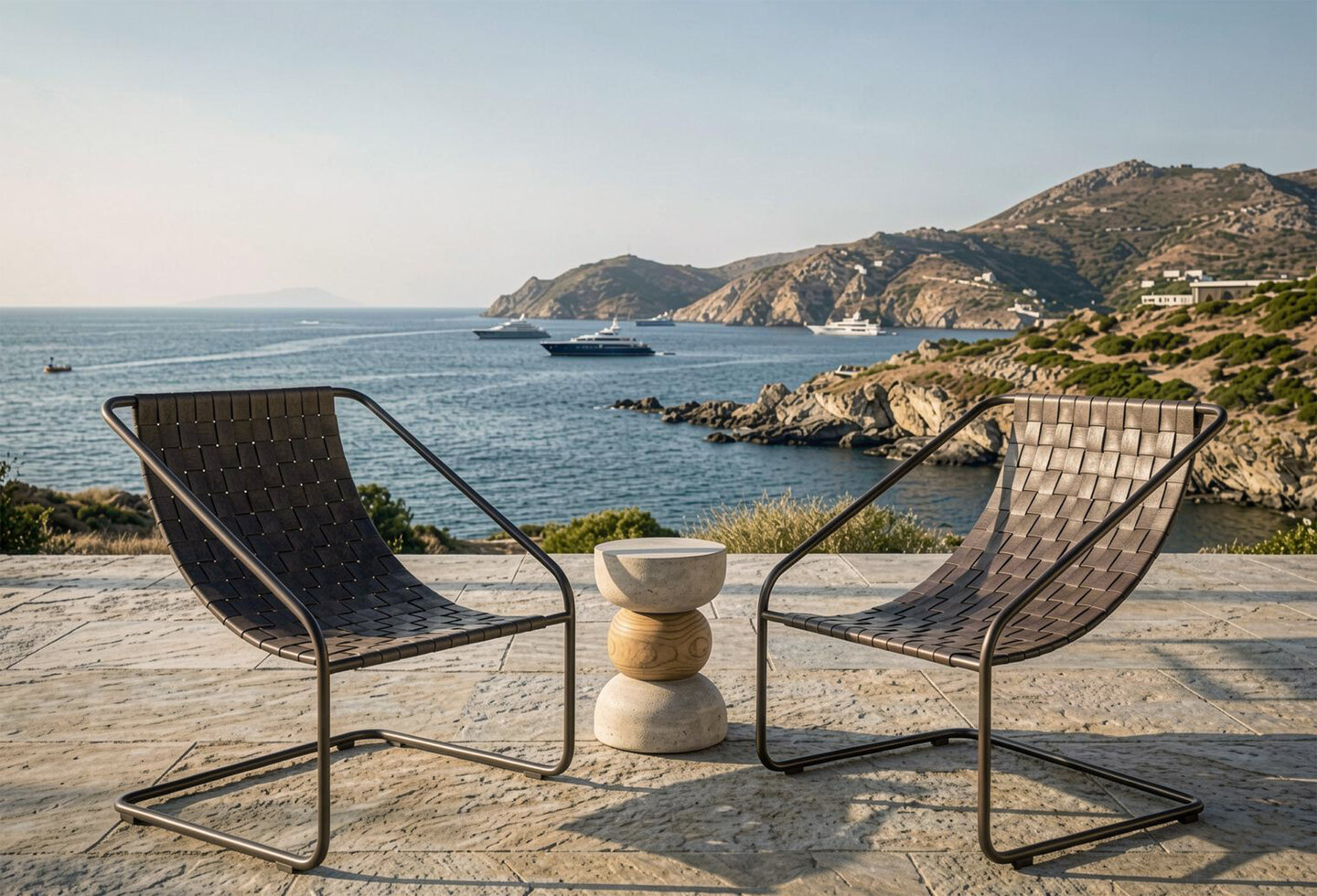
The Nalu collection by Ludovica Serafini and Roberto Palomba appeared in new colours, continuing its wave-like language of soft curves and lifted forms. The designers’ Rayle In & Out collection made a stronger statement about the brand’s new direction. Inspired by Thai rock formations that seem to float above water, Rayle is designed for both indoor and outdoor use, with the same formal idea expressed through different material treatments. Outdoors, matte lacquered aluminium and thermoformed back-painted glass provide performance and resistance; indoors, tailored upholstery details bring a more intimate sensibility.
Related:
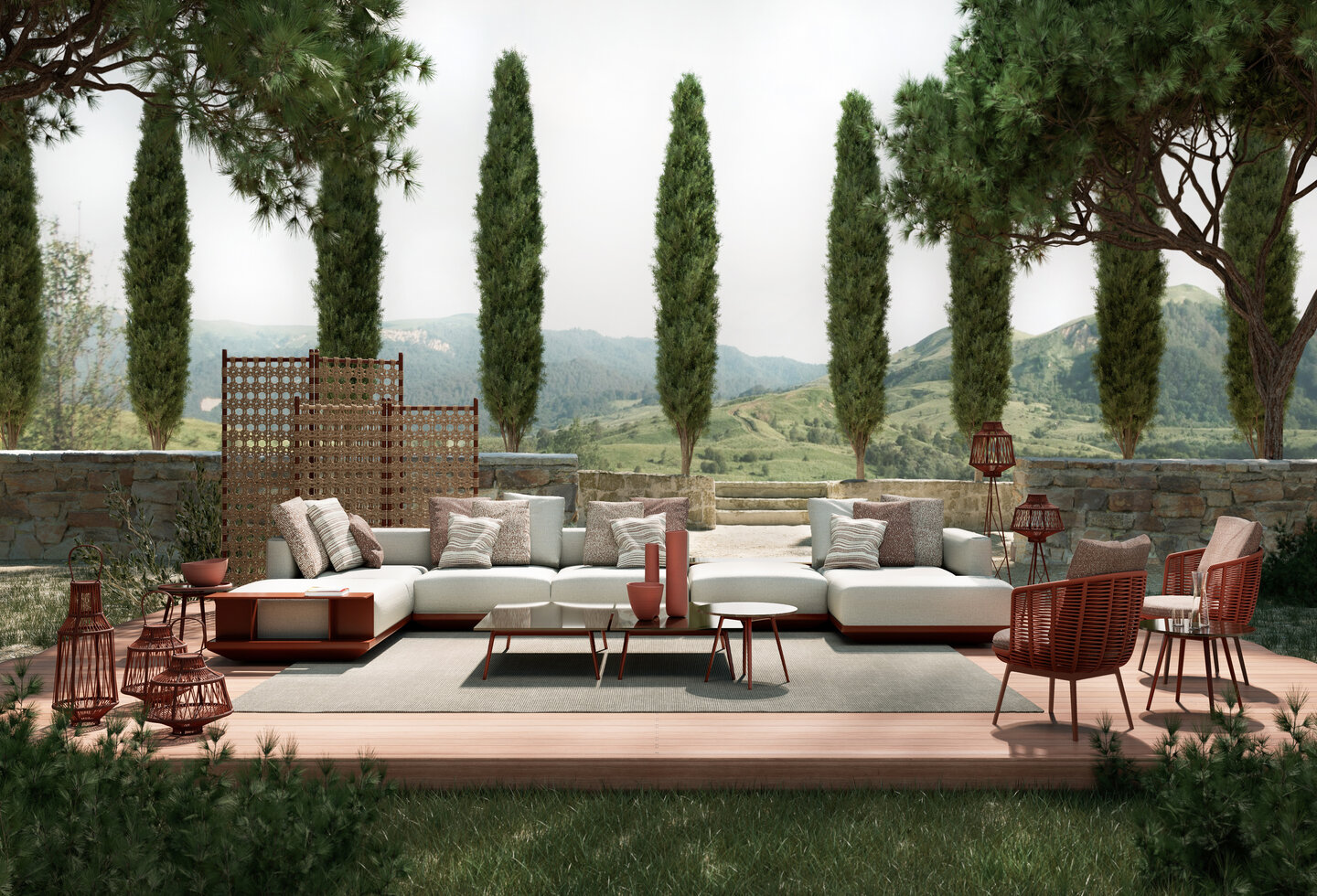
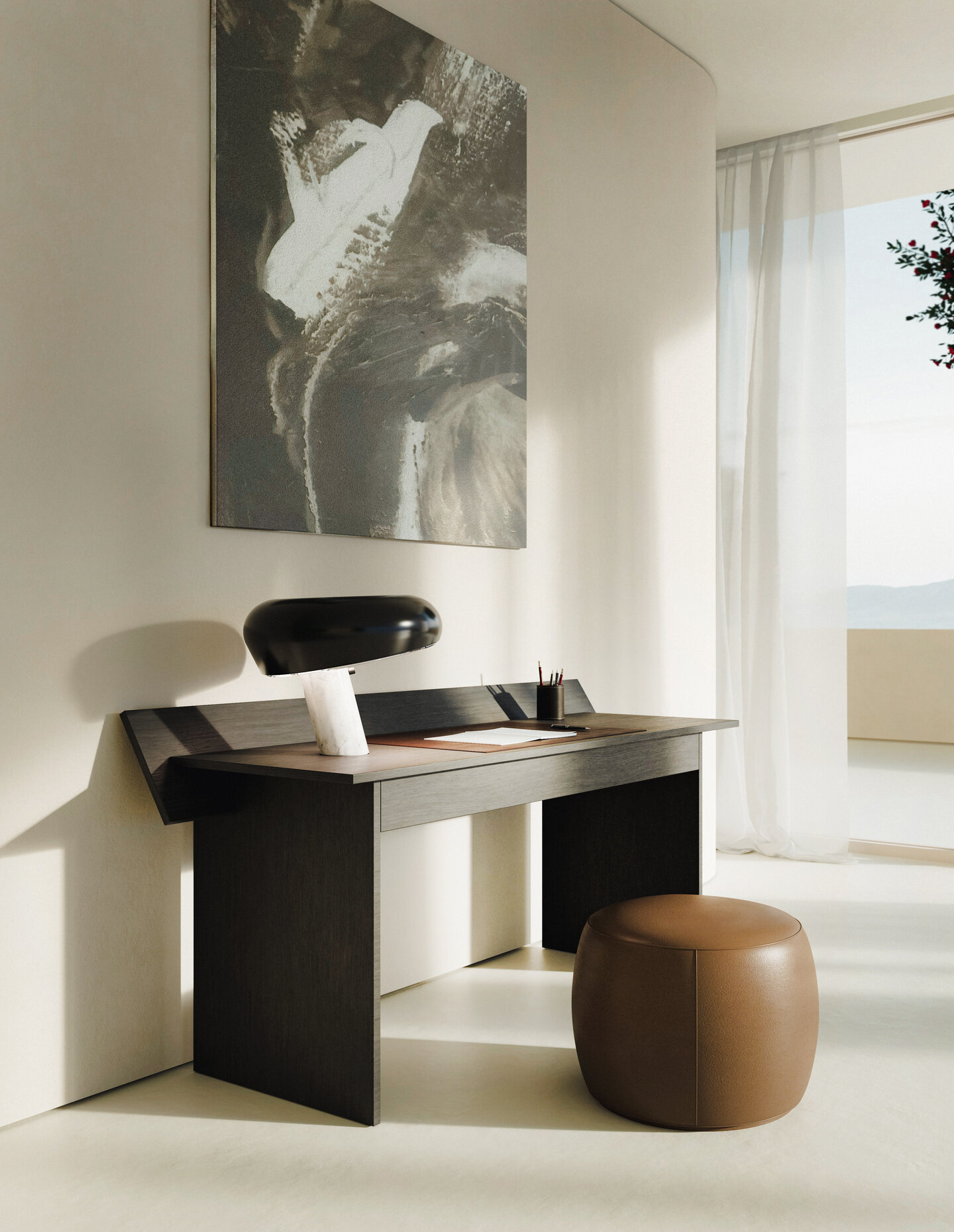
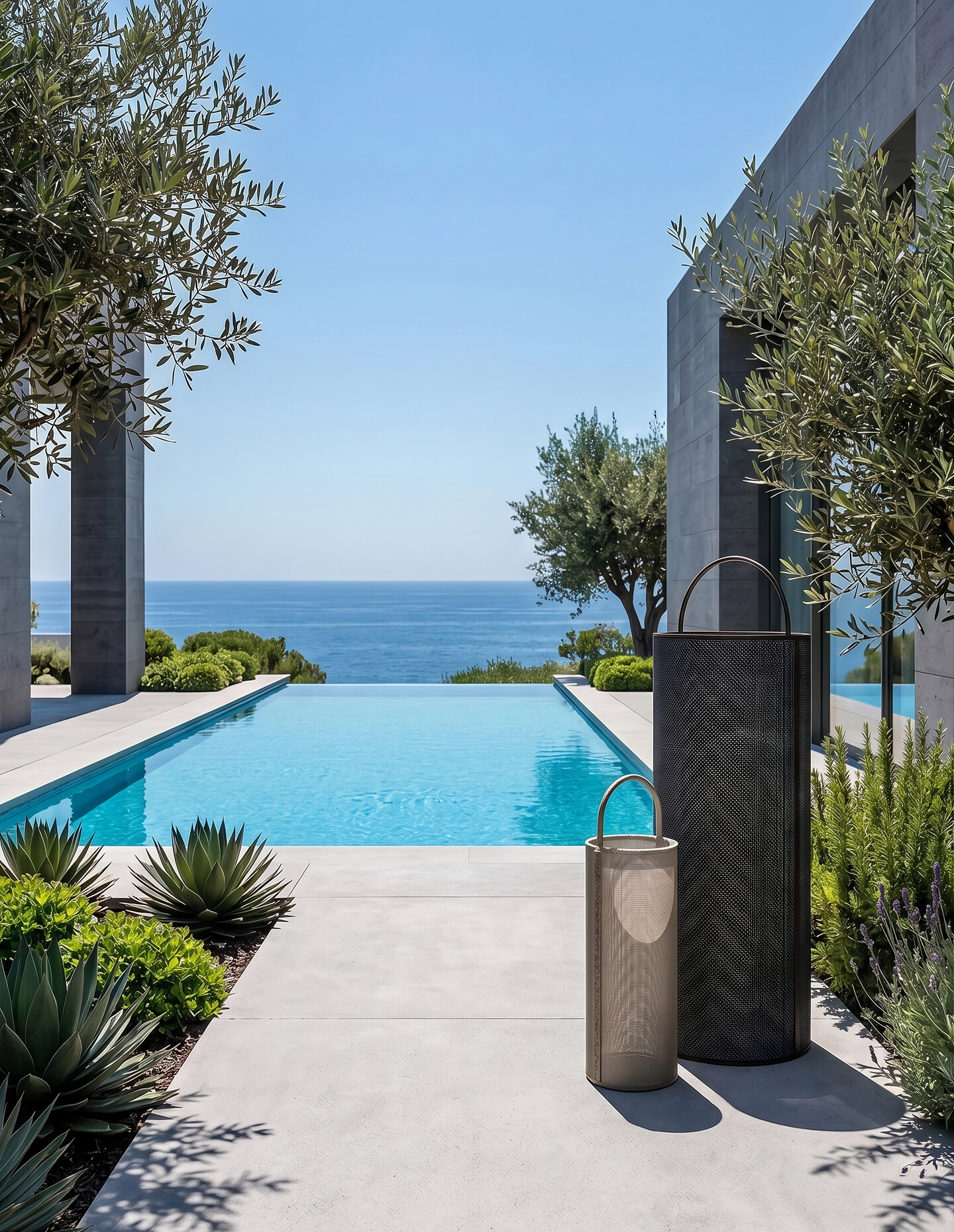
Also presented was Elton In & Out, another Palomba Serafini design focused on adaptive comfort, with modular elements and varied backrest and armrest inclinations. Studio Peia contributed the Anni armchair and Kali coffee table, while Studio Adolini’s Aura and Lukas Gstoettner’s Bikono explored lighting as a portable and atmospheric element of contemporary living.
Laufen
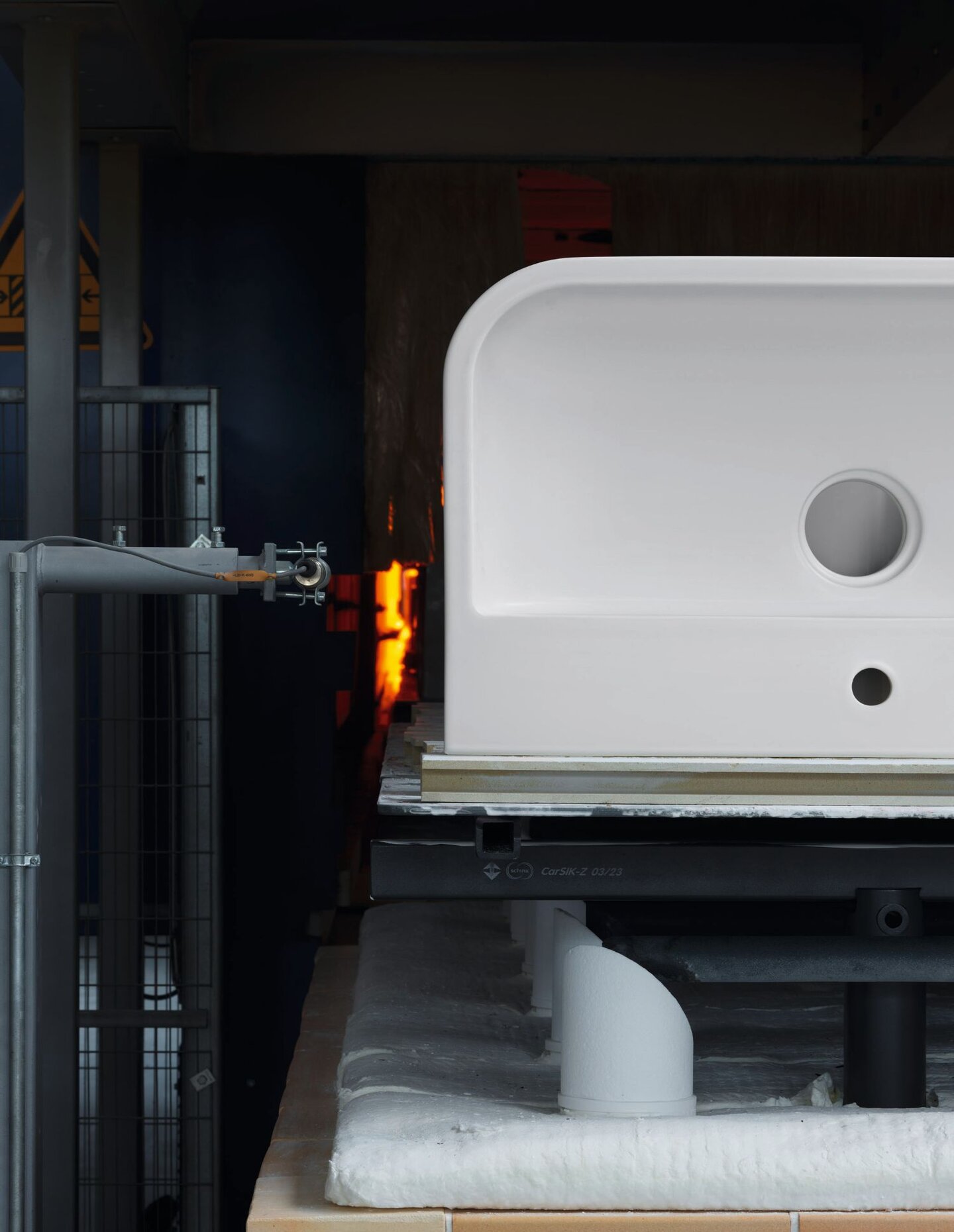
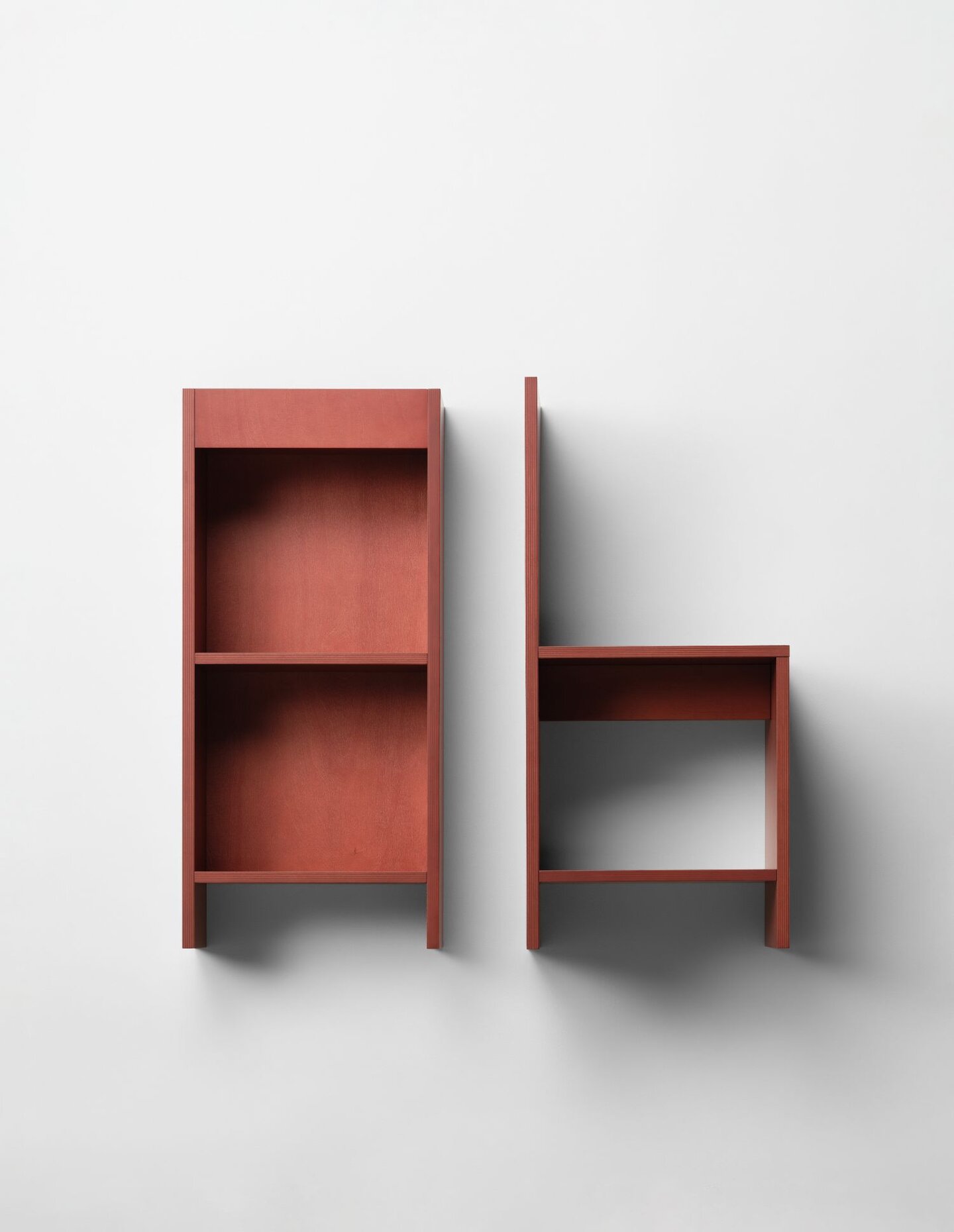
For , Konstantin Grcic has designed PAR, a bathroom collection that translates the passage of time into form, material and use. Created for people in later life, PAR supports daily routines without overtly signalling limitation. It is designed around experienced users who value simplicity, and autonomy, with solutions that are already present when needed rather than added later as afterthoughts.
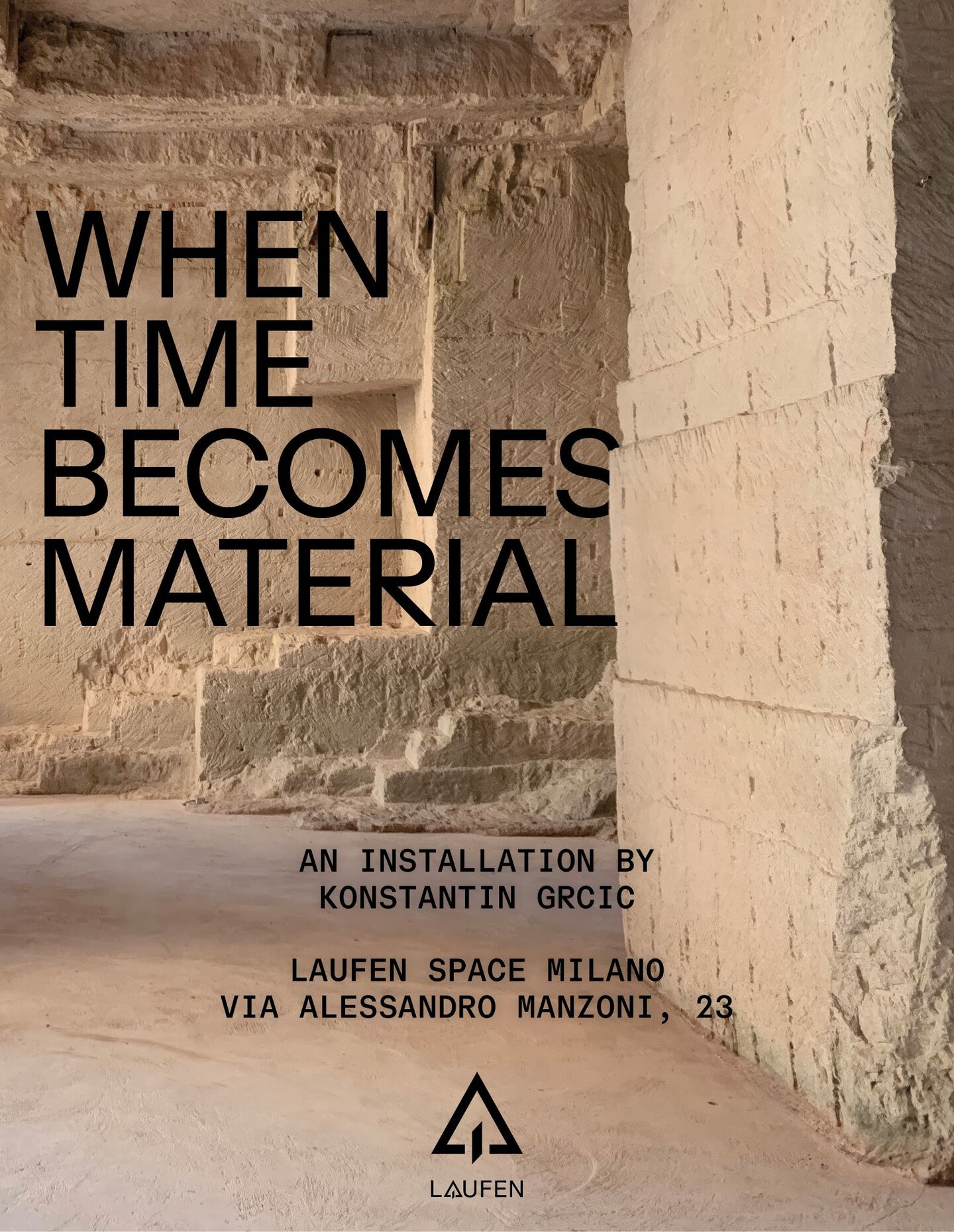
The collection includes washbasins, a drawer element, storage pieces and a T-grab handle bar, with elements made in SaphirKeramik. Its strength lies in how quietly it works. PAR does not treat support as a visible concession, but as part of the bathroom’s architecture. In doing so, it reframes the bathroom as a space that can adapt over time, accompanying changing needs with clarity and dignity.
antoniolupi
At Salone del Mobile Milano 2026, presented a series of new projects within an exhibition architecture inspired by the Roman domus. Organised as a sequence of rooms around a central space, the stand explored the bathroom as a domestic environment shaped by architecture, material and water.
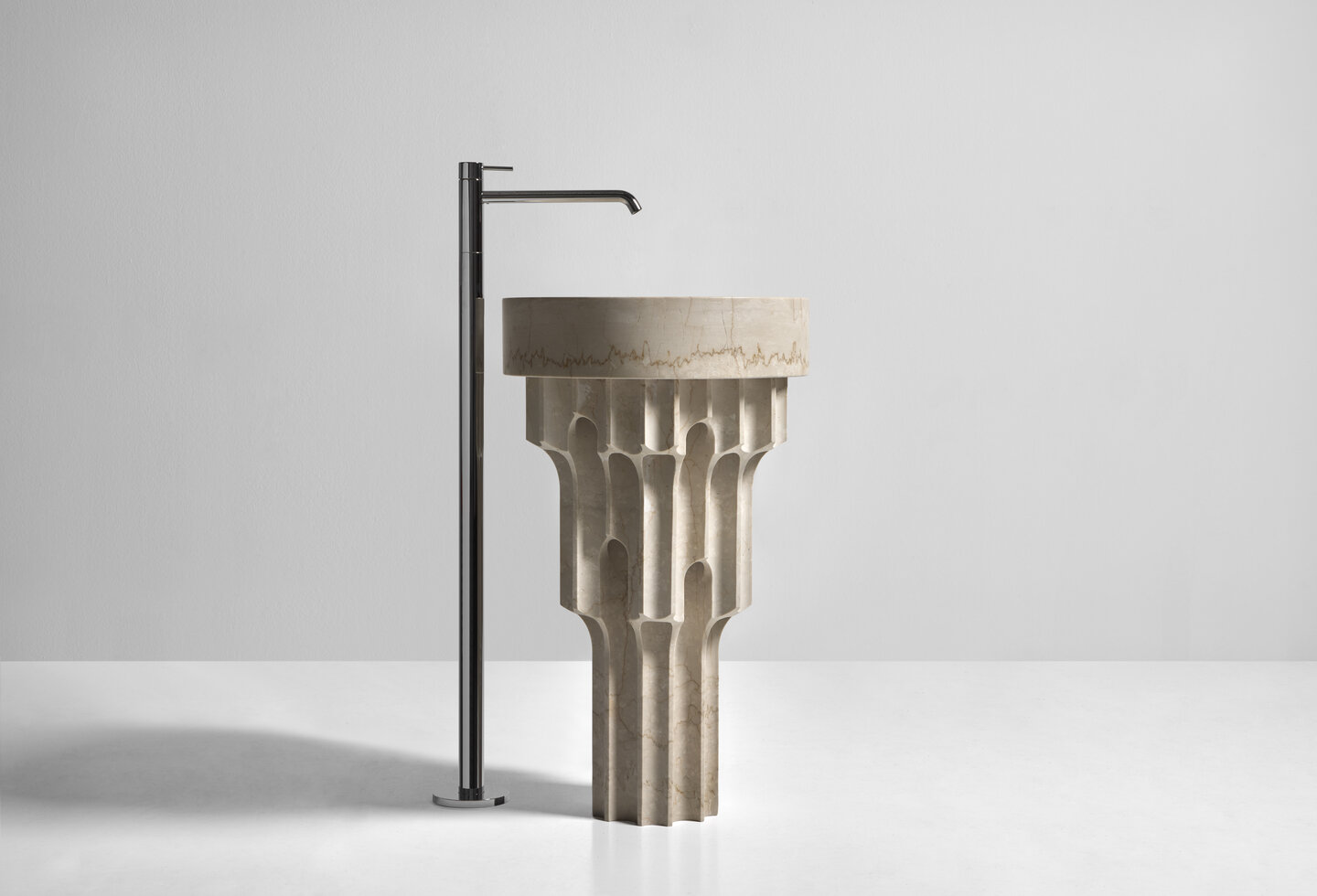
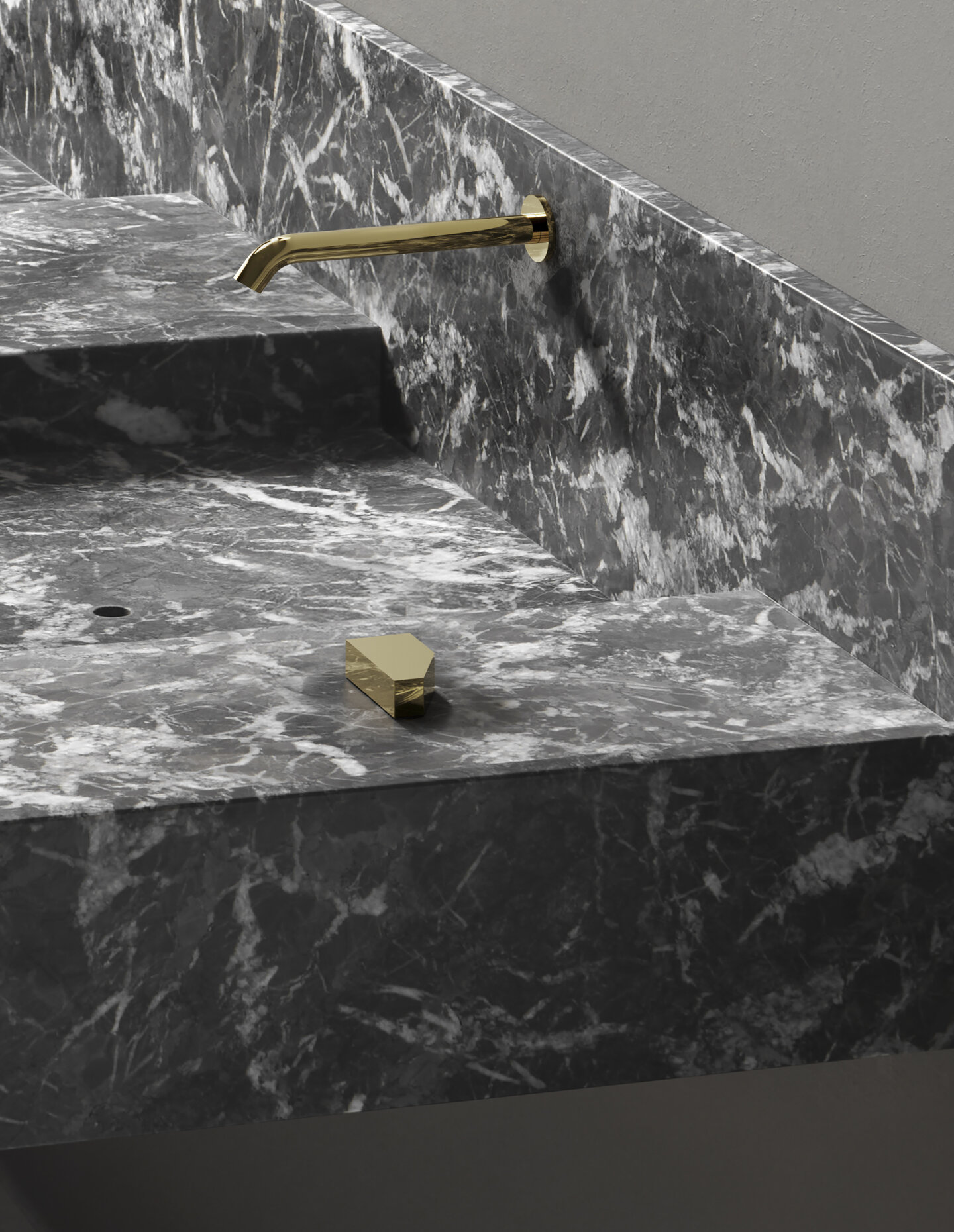
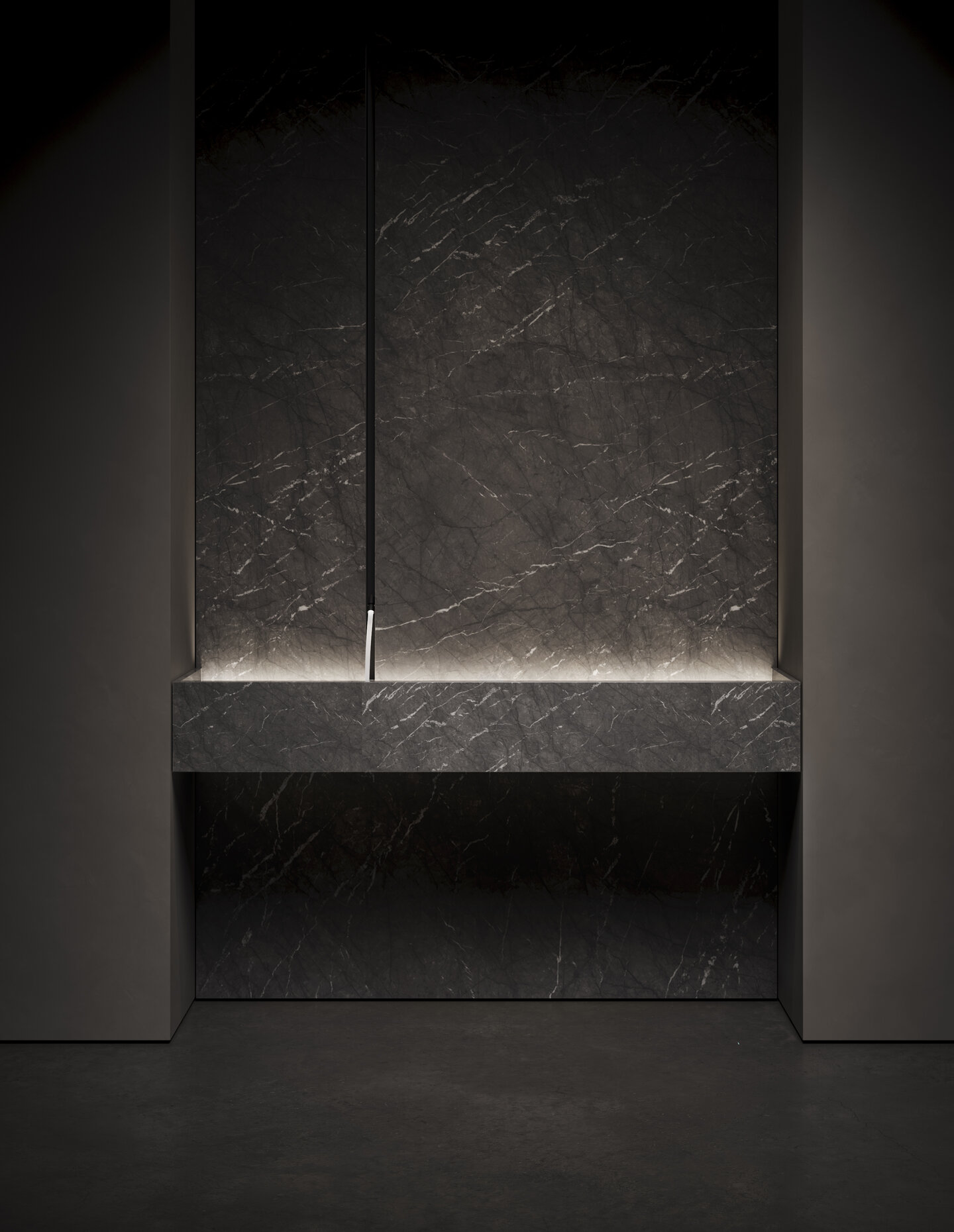
Among the standout launches was Carsico, a freestanding marble basin designed by Paolo Ulian. Hand-carved by specialist artisans, the basin makes visible the core drill holes that are usually hidden within sinks. These technical voids become the defining aesthetic feature of the piece, producing a sculptural composition of solids, cavities, light and shadow. Rather than concealing the process of making, Carsico preserves its traces, allowing imperfections, marks and material variations to become part of the basin’s character.
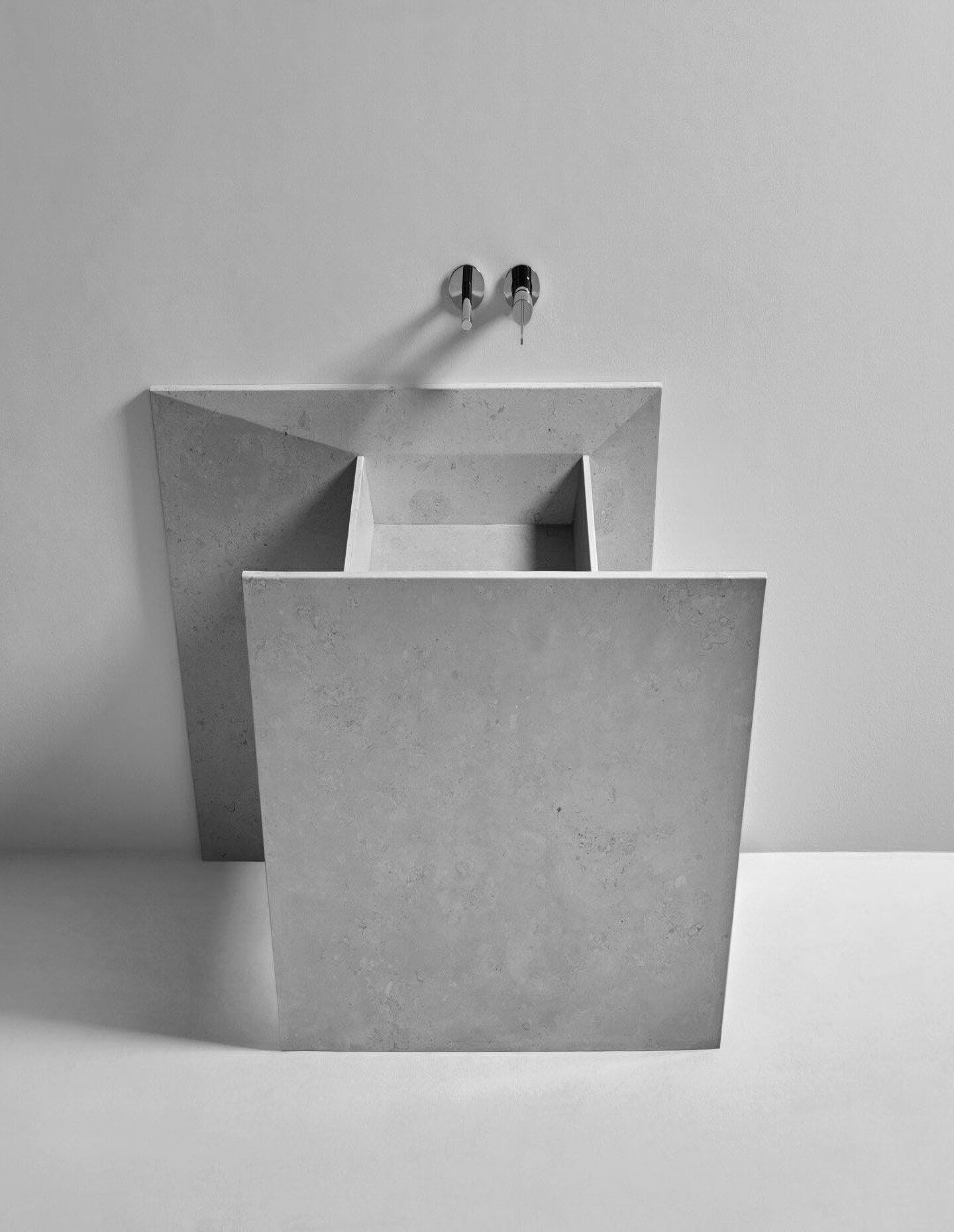
Also presented was Skyline, a marble washbasin designed by Antonio Iraci. Inspired by urban architecture, Skyline is formed from staggered planes and intersecting surfaces, creating a basin that reads almost as a small architectural landscape. Its function is partially concealed from the front, with the object revealing itself through movement. The result is a washbasin that turns an everyday gesture into a spatial encounter with stone, reflection and water.
Further releases included Nazionale, a tapware line by Michele Vitaloni; Lilium, a basin by Brian Sironi inspired by the form of a flower; Slide, a marble bathtub by Carlo Colombo; and a capsule collection of porcelain stoneware surfaces by Carlo Colombo, Gumdesign, Giorgio Rava and Mario Trimarchi.
Molteni&C and UniFor
presented a wide-ranging 2026 offering across kitchen, living and outdoor environments. Physis, the new kitchen designed by Creative Director Vincent Van Duysen, positioned the kitchen as an architectural centre of the home. Rounded edges, soft curves, transparent glass doors, open compartments and integrated lighting create a sense of openness and continuity, while the use of Hinoki veneer introduces warmth, humidity resistance and natural antibacterial properties.
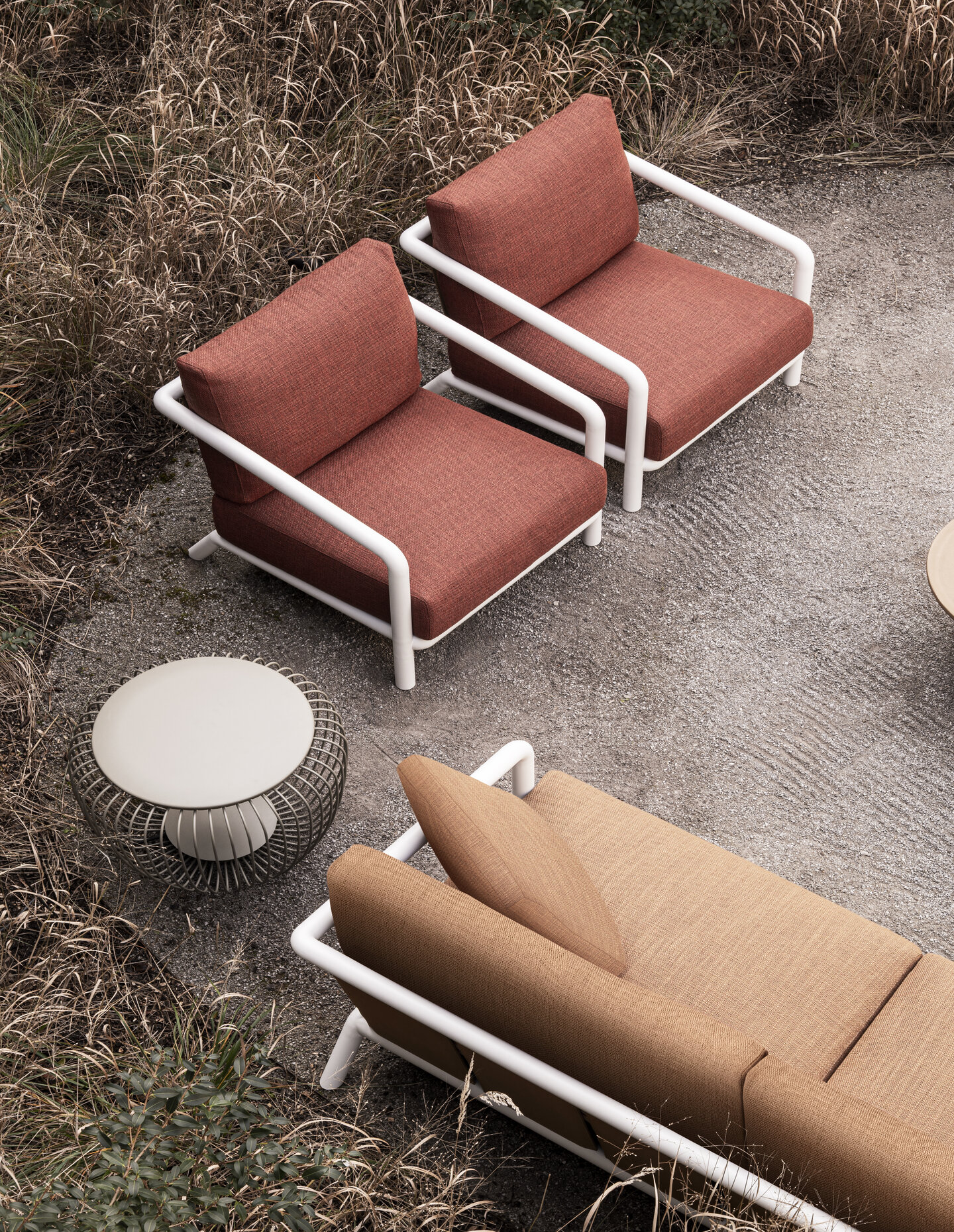
The brand also expanded its outdoor world with a 2026 collection curated by Van Duysen. Soleva, his new outdoor family, includes sofas, armchairs, chairs, stools, sunbeds and tables. Named in relation to the sun, the collection balances slender powder-coated tubular aluminium frames with marine plywood slats, outdoor cushions and quiet proportions. It is joined by Chelsea Outdoor by Dordoni Studio, which reinterprets the indoor Chelsea family for exterior use through aluminium structures and handwoven polypropylene rope, and Club by Yabu Pushelberg, a folding chair designed around mobility, lightness and outdoor ease.
Lighting also played an important role, with Molteni&C partnering with Vibia on outdoor pieces including Meridiano and Out. Meridiano combines seating and illumination in a sculptural freestanding form, while Out offers portable, softly diffused light for terraces, gardens and open-air settings.
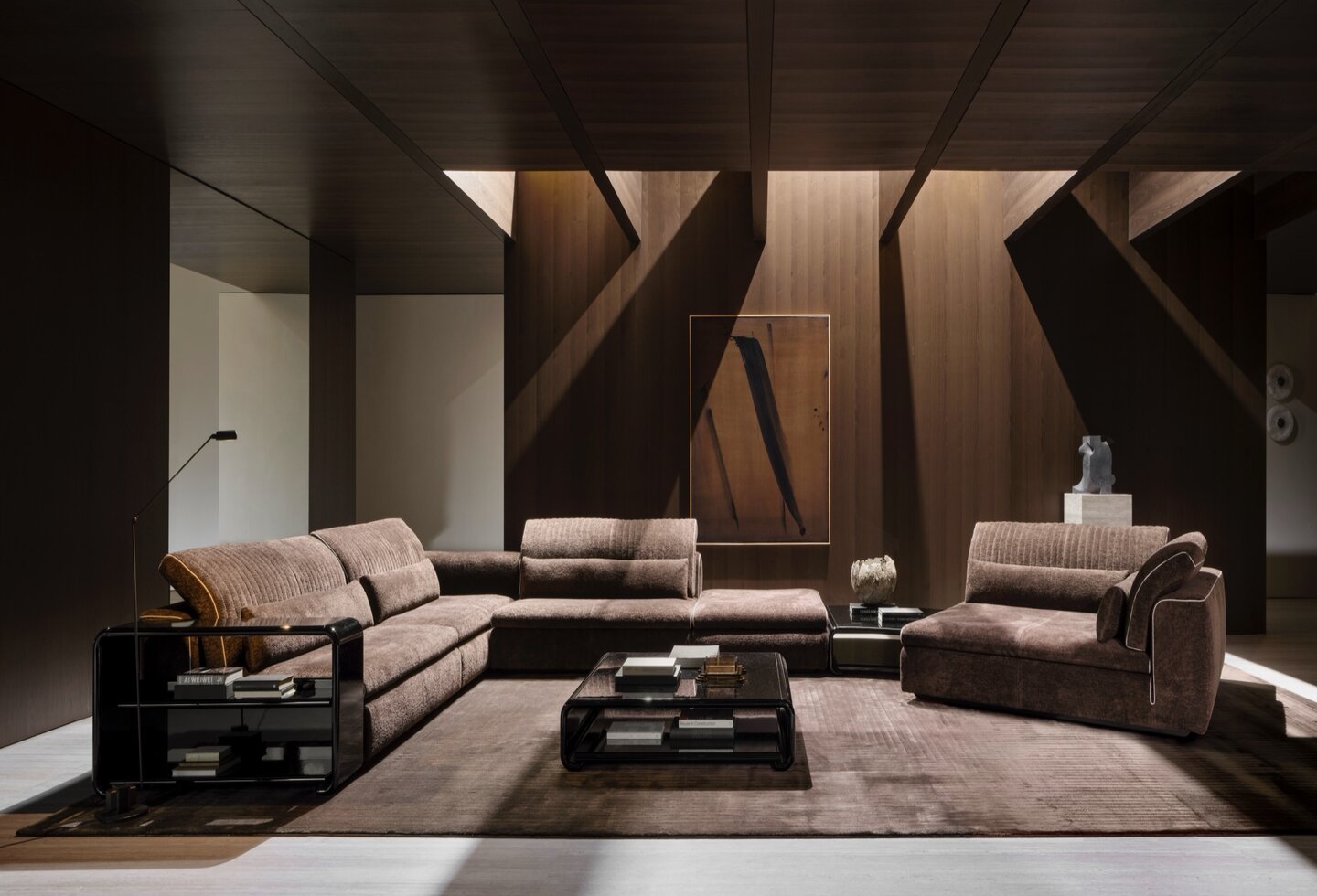
Indoors, Van Duysen introduced Julian, a modular sofa system defined by deep seating, contrasting piping and flexible configurations, alongside Eter, a sculptural coffee table with curved surfaces and a suspended bridge-like structure.
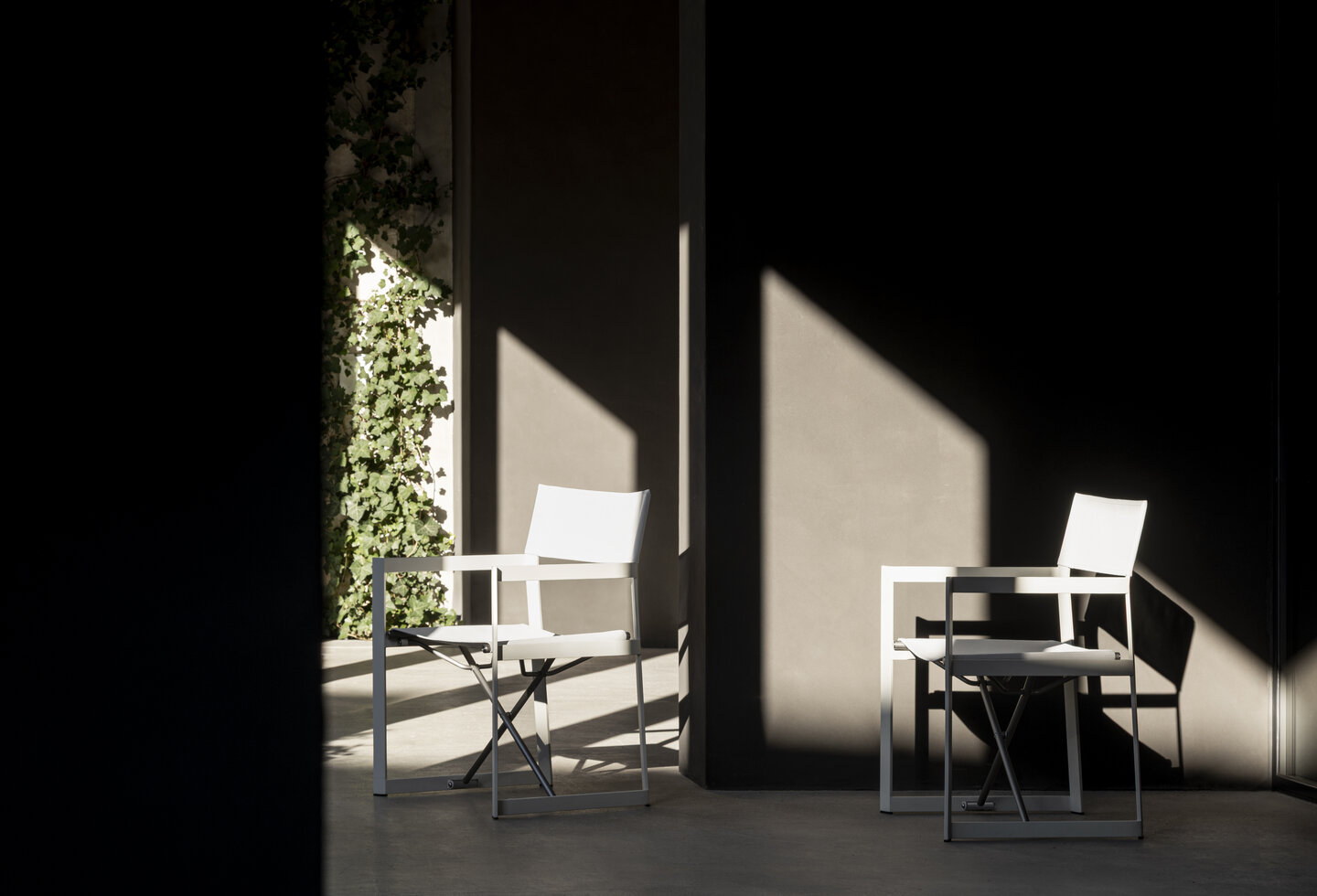
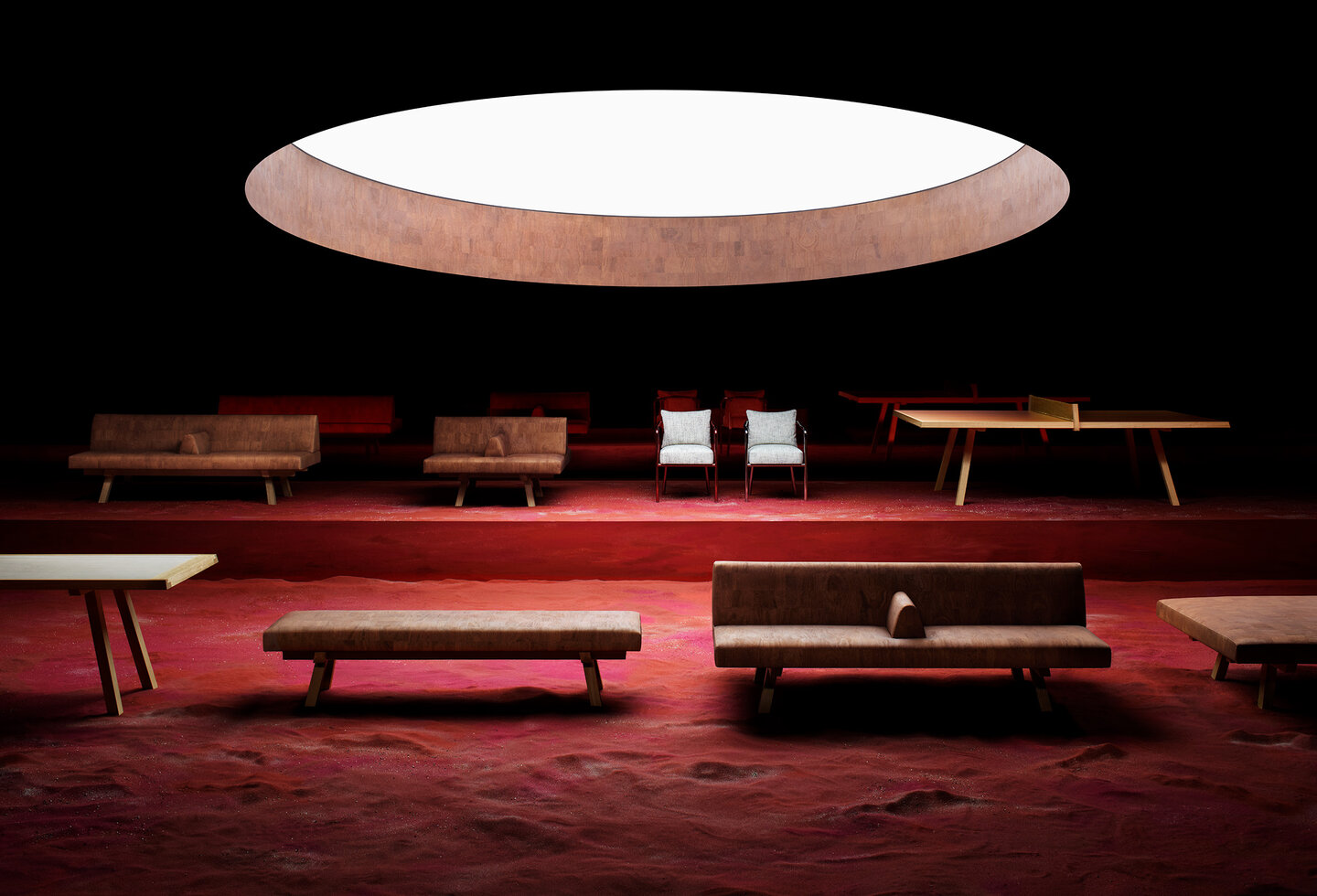
For UniFor, Herzog & de Meuron designed MTM – Made to Measure, a furniture system based on a single constructive matrix. Solid angled frames stabilise slender horizontal elements, allowing the system to extend across tables, benches, sofas, coffee tables and even a ping pong table. With solid wood structures, travertine and coloured glass tops, and cork upholstery, MTM is designed to adapt across public, institutional and professional settings while maintaining a coherent architectural language.
Poliform
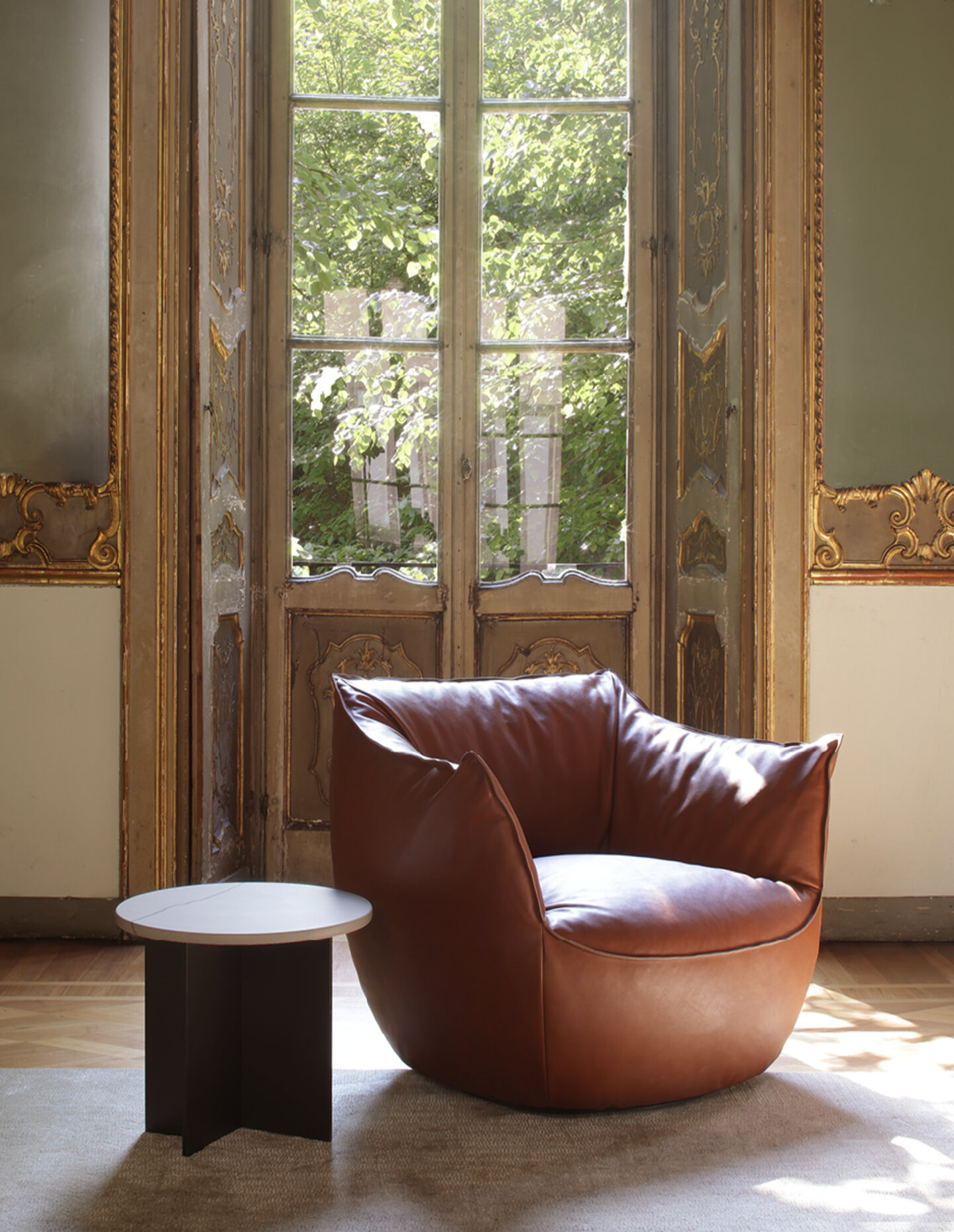
’s 2026 releases continued the brand’s exploration of comfort, proportion and quiet formal strength. Jean-Marie Massaud’s Alfred armchair is conceived as a single soft volume upholstered in leather or fabric. While informal and contemporary, it retains the familiar presence of a classic lounge chair, with a removable cover and options for a fixed or swivel base.
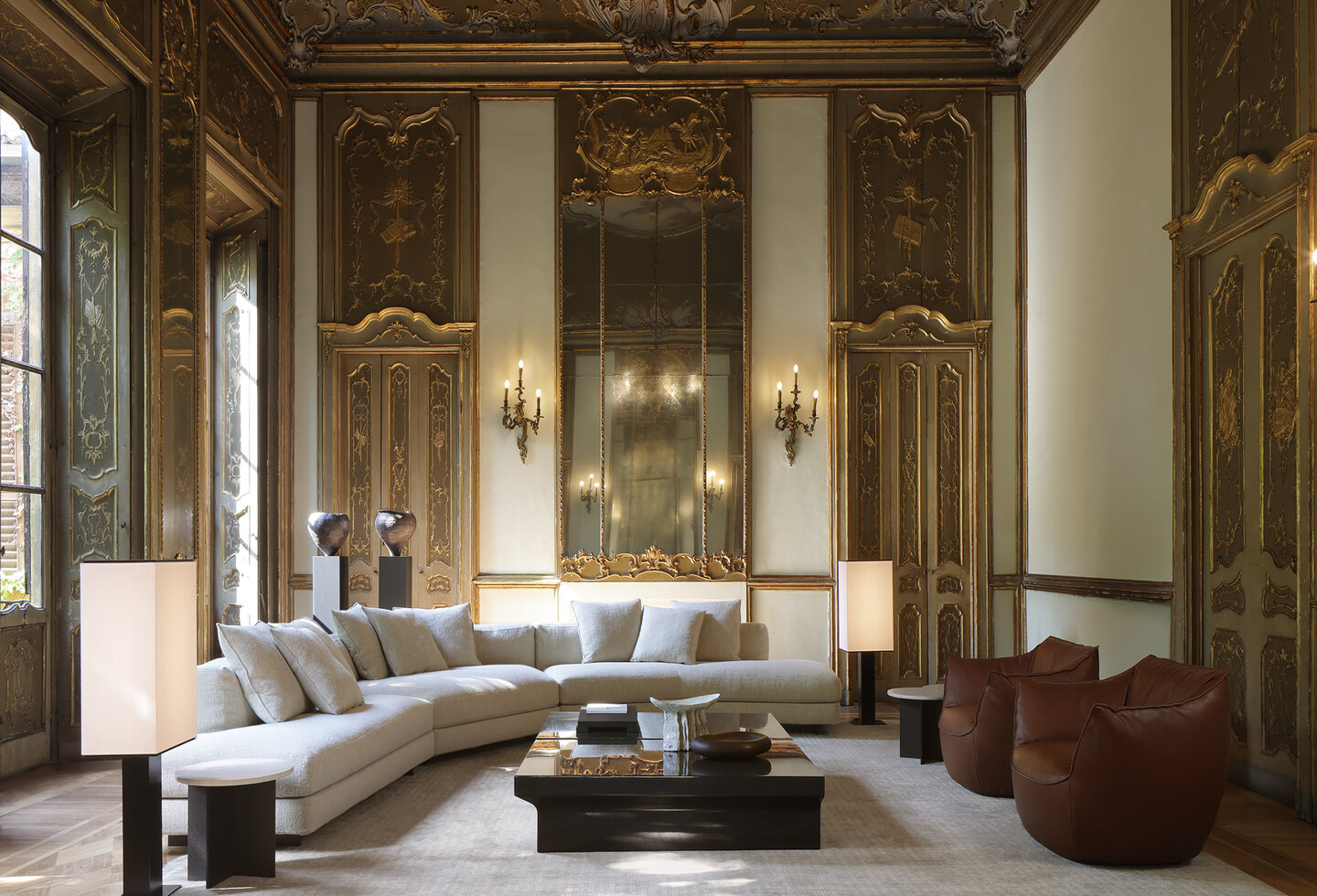
Massaud also designed the Savoy sofa, a modular system that brings together geometric purity and softness. Its visible structure supports generous cushions, creating what Poliform describes as an architecture of comfort. Available in broad configurations for substantial living spaces, Savoy balances protection and relaxation, with removable upholstery and refined back finishes in black elm or glossy lacquer.
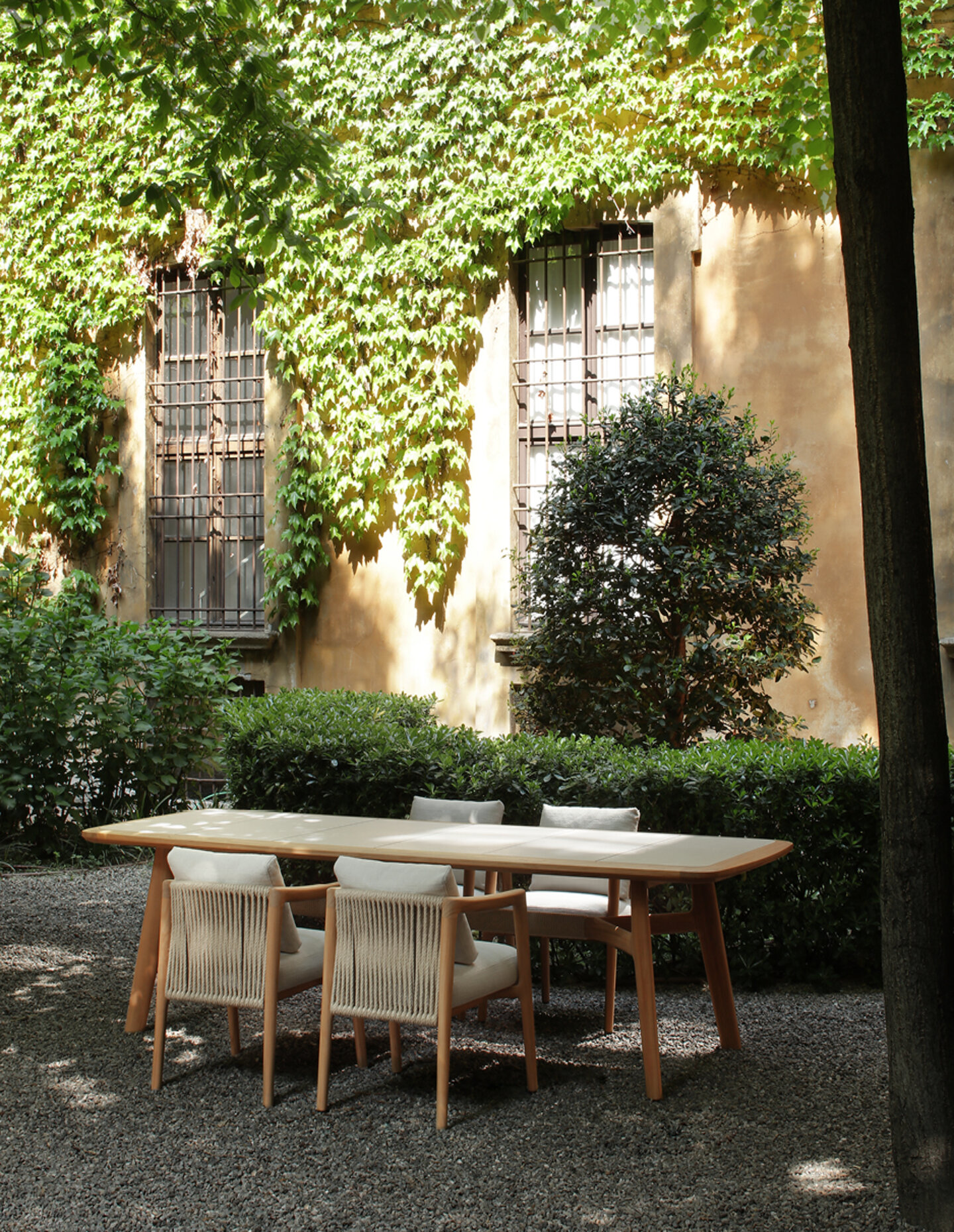
For outdoor dining, Emmanuel Gallina’s Curve table brings Poliform’s dining language into the open air. Crafted in solid teak, with a slatted or ceramic top, the table is distinguished by a rope-wrapped crosspiece that references the world of sailing. The result is a piece that feels robust, tactile and composed, with enough refinement to bridge terrace, garden and architectural outdoor rooms.
Pedrali
marked the tenth anniversary of Dome, the Odo Fioravanti-designed seating collection first presented at Salone del Mobile Milano in 2016. Over the past decade, Dome has become one of the brand’s most recognisable icons, bringing together the tradition of the bistro chair with references to domes, cathedrals and cupolas.
The collection is made from glass fibre reinforced polypropylene and is available in versions with or without armrests, and with solid or perforated seat and backrest. Its intelligence lies in how a mono-material product appears to speak several material languages at once. Some details recall the joints of wooden chairs, while the perforated versions suggest the lightness and industrial character of metal.
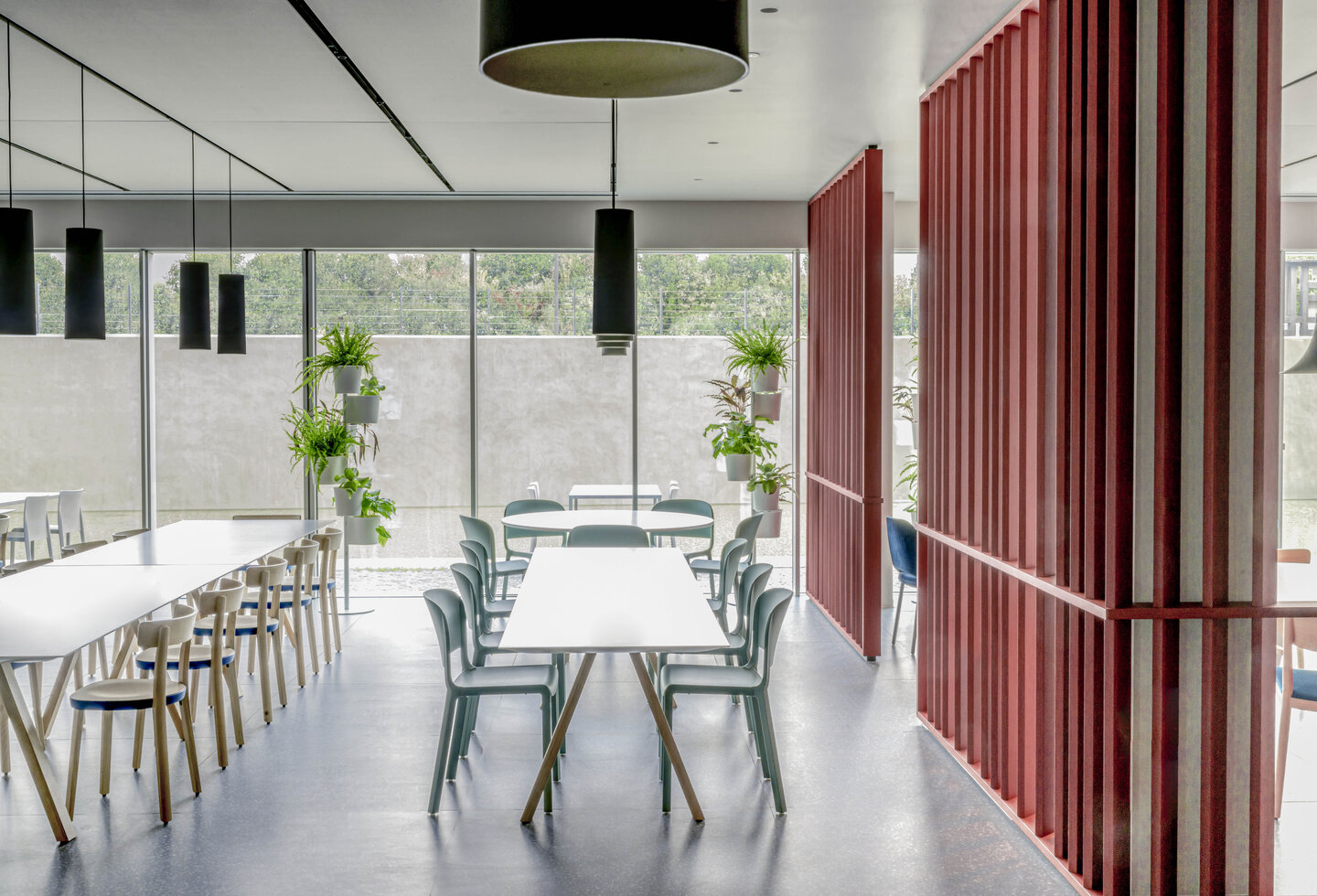
Dome’s success also comes from its range of use. Suitable for indoor and outdoor settings, it has appeared across schools, workplaces, public buildings, restaurants, hotels and cultural spaces. Ten years on, the collection remains a strong example of how a simple chair can gain longevity through clarity, adaptability and material precision.
Nikari
Finnish brand Nikari presented new releases that continued its long-standing focus on solid wood, craft and environmental sensitivity. Akademia Lounge, designed by Kaksikko, extends the Akademia series into a more relaxed typology. Made in solid oak with upholstery, the chair translates the language of the original Akademia dining chair into a generous lounge form, with oversized proportions and bent back legs giving it a calmer, more informal presence.
The Akademia series draws on Shaker simplicity, Japanese design traditions and Finnish craftsmanship, and the lounge version carries those references without excess. It is a chair built around material honesty, proportion and long sitting.
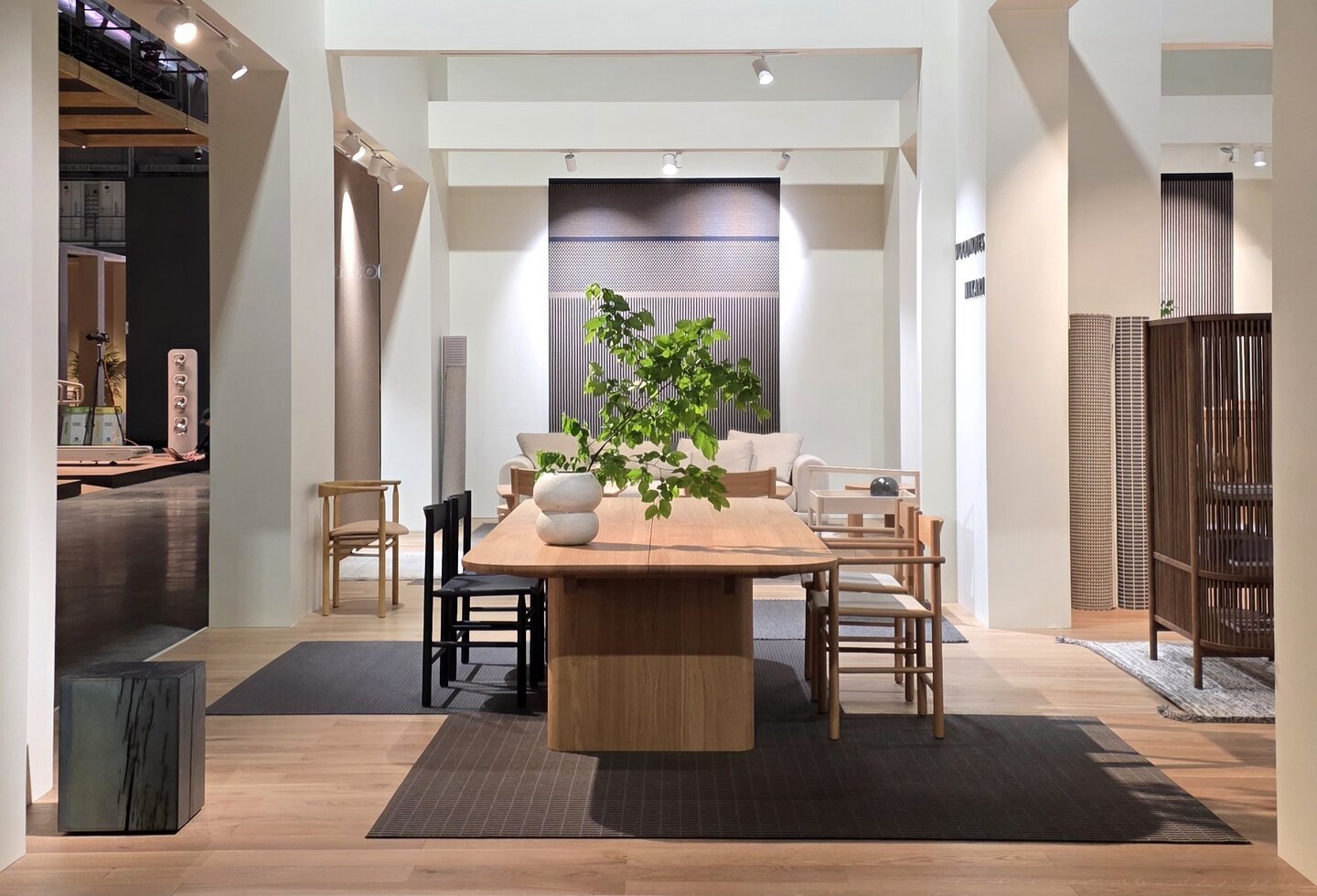
Joanna Laajisto’s Centenniale Round expands the Centenniale family with a new circular coffee table. Made from solid oak, the piece allows knots, cracks, wormholes and unevenness to remain visible, treating these qualities not as imperfections but as the essence of the material. The name refers both to the age of the wood and to the idea of furniture made to last for centuries.
Nikari also introduced BIENNALE Shimber, a limited-edition version of its Biennale stool-table using Shimber, a 100 per cent bio-based structural colour coating. Developed without traditional pigments, the coating creates a shifting optical effect inspired by natural phenomena such as butterfly wings. Applied to two sides of the oak or black-stained stool-table, it brings a more experimental material note to Nikari’s otherwise quiet wood-based language.
Together, the releases suggest a Milan Design Week mood less interested in novelty for its own sake than in products that can hold time: through use, adaptability, material depth and the everyday rituals of living.
ASKO
ASKO’s Professional range brings the brand’s Scandinavian restraint into commercial laundry, with appliances designed for endurance and repeated daily use. Built for environments ranging from hotels, restaurants and health clinics to salons, self-service laundries and marine settings, the collection positions the washing machine less as a back-of-house utility and more as a reliable, integrated co-worker.
The washing machine range is designed around professional performance, with models tested for up to 15,000 or 30,000 cycles and capacities spanning 7kg and 9kg. Features such as EasyControl TFT display, Active Drum, Quattro Construction and motor weight control support both usability and long-term operation, while external dosing capability allows detergent use to be adjusted according to load weight.
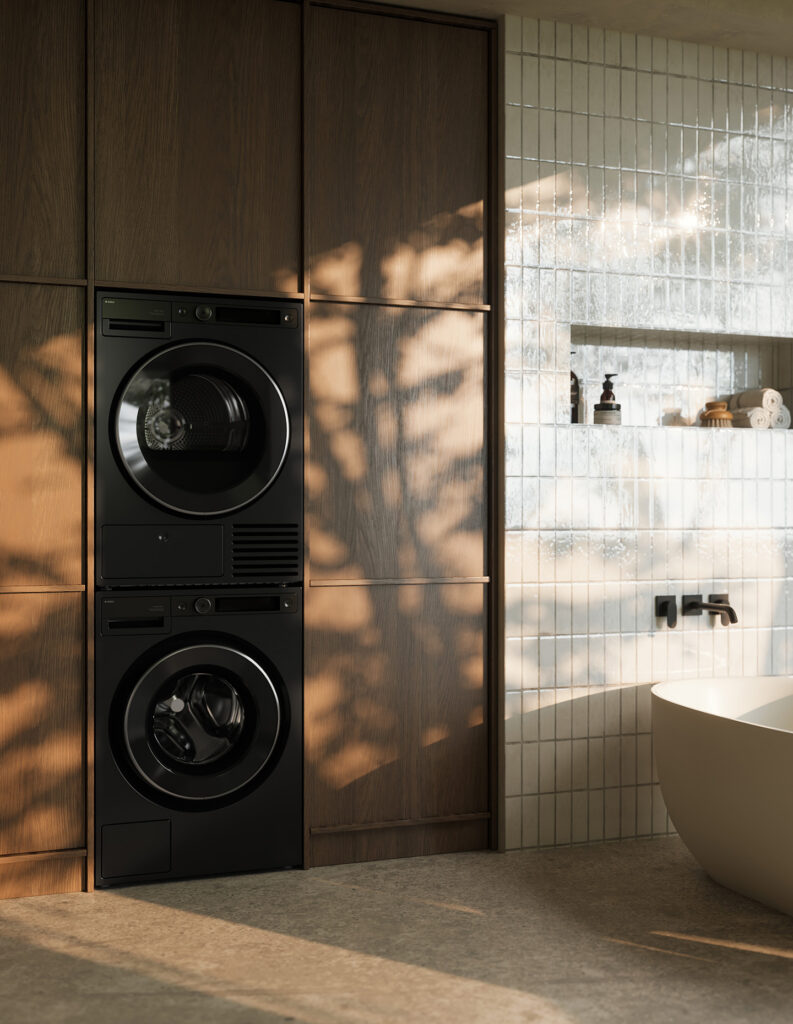
ASKO also places hygiene at the centre of the range. Its Steel Seal construction removes the traditional rubber bellows, reducing places where bacteria and mould can collect, while selected models include disinfection programs. In this context, the washing machine becomes a study in robust, precise and practical design — made for the kind of everyday labour that depends on consistency, durability and care.
Fisher & Paykel
Fisher & Paykel presented Nature — Ritual at EuroCucina 2026, an immersive expression of the brand’s life-centred design philosophy. Rooted in the landscapes and material sensibilities of Aotearoa New Zealand, the exhibition explored how daily routines can become rituals through atmosphere, technology and material connection.
At the centre of the presentation was the brand’s State of the Art Collection and the evolution of its Minimal Style, both conceived as refined, visually recessive systems for material-led spaces. Rather than foregrounding the appliance as an object, Fisher & Paykel focused on the way appliances disappear into architecture, supporting kitchens that feel calm and intuitive.
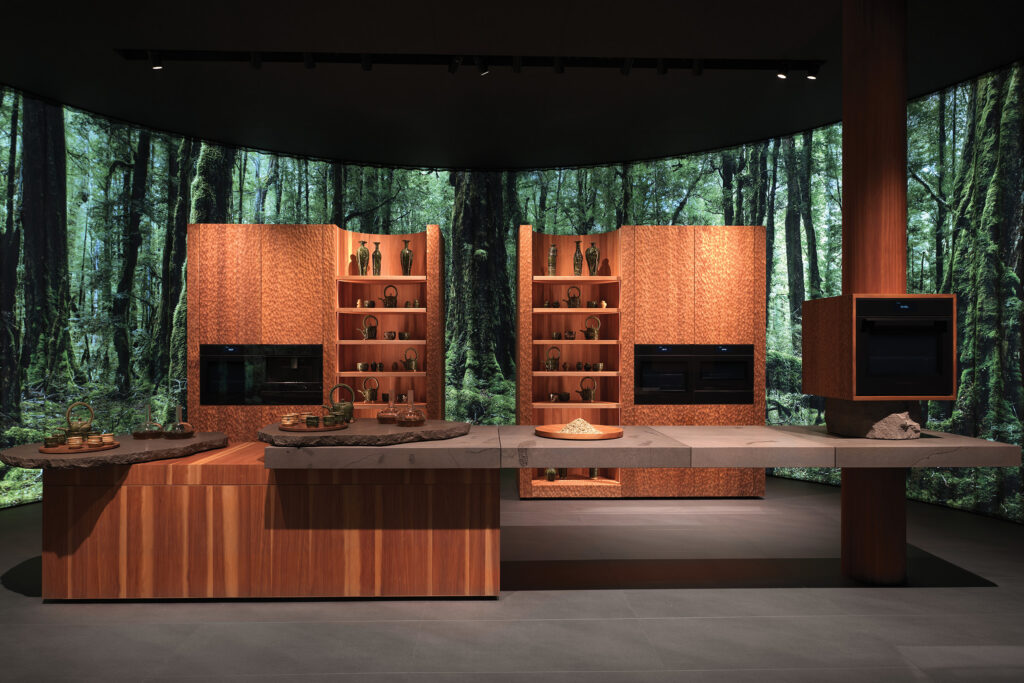
Materials played an important role. Tōtara and basalt were used to express a design language of contrast: warmth and weight, tactility and permanence. In doing so, Nature — Ritual positioned the kitchen as more than a place of function. It became a setting for care, social connection and the repeated gestures that shape domestic life.
GROHE
GROHE’s Milan Design Week presentation continued the bathroom’s movement toward wellness, atmosphere and architectural integration. With GROHE SPA Aqua Sanctuary, the brand explored water as a sensory and spatial material, presenting the bathroom not simply as a functional room, but as a place of ritual, restoration and highly personalised design.
Within the installation, GROHE SPA Atrio Private Collection was shown as part of a fully integrated bathroom environment, centred around a continuous cascade waterfall. The collection brought together premium materials, refined finishes and handle designs with quartz inserts, while the GROHE SPA x Buster + Punch collaboration extended this language across metal hardware, lighting and water solutions.
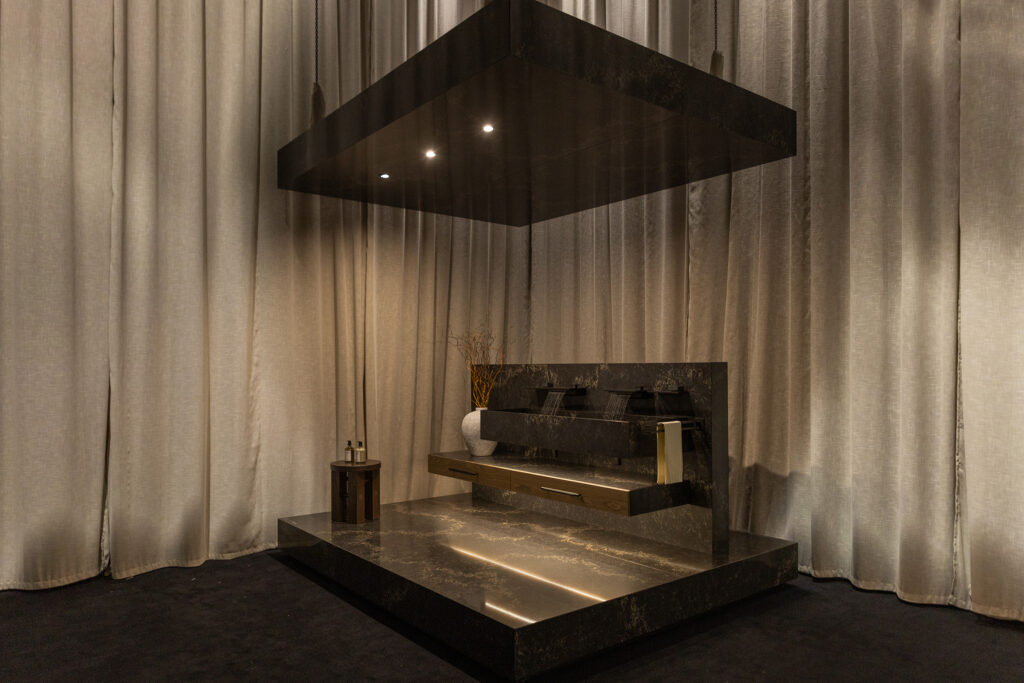
GROHE also presented Allure Gravity in Phantom Black with Caesarstone Vanilla Noir details, alongside Rainshower Aqua Tiles and flush-mounted Grohtherm controls. These pieces were arranged around the rituals of preparation, relaxation and rejuvenation, with technology designed to recede so that water, tactility and atmosphere could take precedence. Material innovation also formed part of the story, with revia, a circular material made from recycled waste, and PremiAL R100, a low-carbon material made from 100 per cent recycled aluminium, suggesting a future where luxury and environmental responsibility are more closely aligned.
Moooi x Superstudio
Moooi marked its twenty-fifth anniversary at Milan Design Week with Moooi 25 and Promising, an immersive celebration staged with Superstudio, the site of the brand’s first Milan presentation 25 years ago. Wrapped in silver, the exhibition treated the anniversary as a moment of reinvention, bringing together new releases, reimagined icons and experimental gestures.
Among the new introductions was Urchina Light by Studio Roderick Vos, a floating constellation of carbon rods inspired by the symmetry of sea urchins. Paul Cocksedge’s Push Light turned a simple physical gesture into illumination, while Moooi Wallcovering introduced Monumental Moments and Moooi Carpets presented Future Fossils by Kilian Vos. Existing pieces also returned in new forms, including Meshmatics in additional sizes and formats, Paper Chandelier in three sizes and Common Comrades in smoked bamboo.
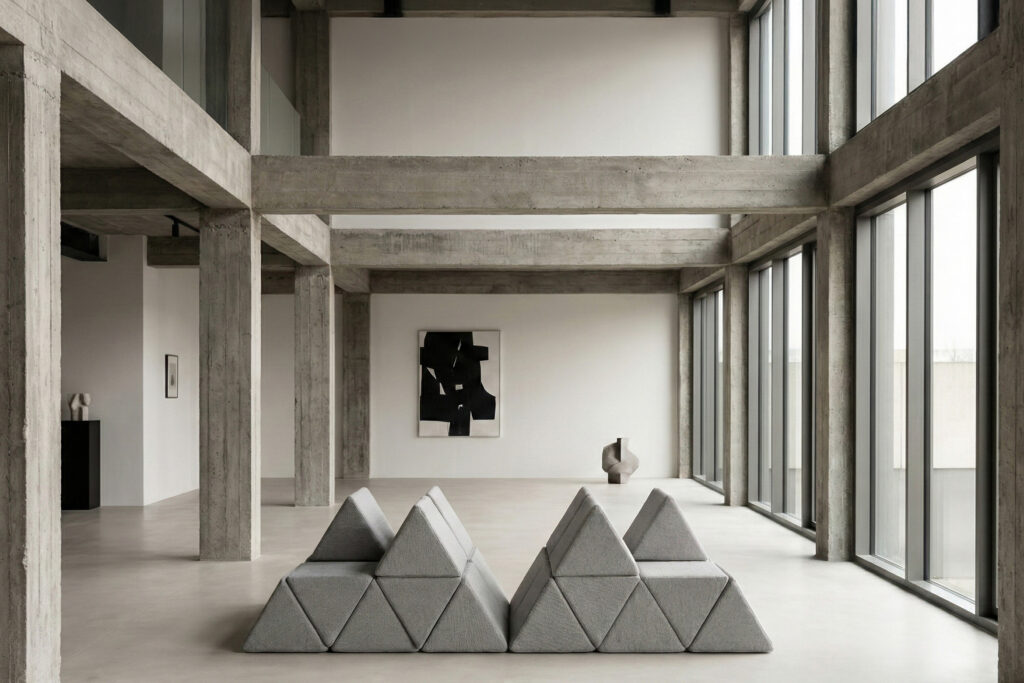
The presentation also looked ahead. Powerline, Moooi’s first architectural lighting collection developed with Intra Lighting, signalled an expansion from expressive objects into more complete lighting systems. Pino Tree by Andrés Reisinger added a surreal, kinetic note, with illuminated rotating trees forming a forest-like installation. Together, the releases reflected Moooi’s ongoing interest in interiors as emotional landscapes, where objects are allowed to be strange, theatrical and deeply memorable.
Rimadesio
Rimadesio used Milan Design Week 2026 to celebrate its 70th anniversary with BECOMING, a multidisciplinary project staged across design, architecture and art. Conceived as four acts, the project framed the brand’s history not as an evolving language shaped by innovation, restraint and a continuous dialogue with contemporary living.
At the centre of the new collection was Giuseppe Bavuso, whose long collaboration with Rimadesio has helped define the brand’s precise and measured design identity. For 2026, the collection expanded through new materials, finishes, systems and furniture elements, presented in the brand’s Milan showroom on Via Visconti di Modrone. The emphasis remained on modularity, spatial clarity and technical refinement, with solutions spanning living systems, bookcases, sliding panels, hinged doors, wardrobes and accessories.
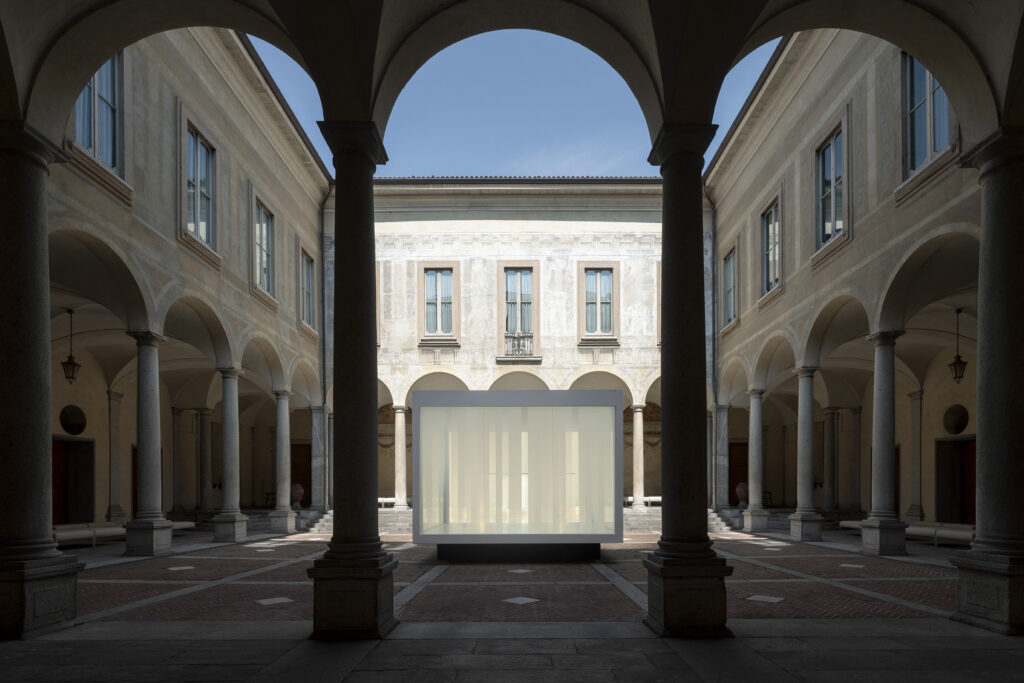
Rimadesio’s strength lies in its ability to make space itself feel designed. Rather than treating furniture as isolated pieces, the brand works through systems that organise, divide and connect interiors. In the context of Milan Design Week, BECOMING positioned the company’s 70-year history as an ongoing process: one where memory, technology and architectural thinking continue to shape each other.
B&B Italia
B&B Italia returned to Salone del Mobile in 2026 with considerable symbolic weight, marking its first major presence at the fair in 25 years. The presentation brought together new products, expanded collections and archival reissues, with contributions from Ronan Bouroullec, Jasper Morrison, Antonio Citterio, Vincent Van Duysen and Michael Anastassiades, alongside the return of Richard Sapper’s Nena armchair and limited-edition Catilina chairs by Luigi Caccia Dominioni.
The stand, designed by Formafantasma, avoided the familiar language of styled domestic rooms. Instead, it placed the products within a restrained architectural framework, using proportion, light, wood, marble and coconut fibre carpets to create atmosphere without overdetermining context. This allowed each piece to be read as an autonomous design project, foregrounding material, form and design logic.
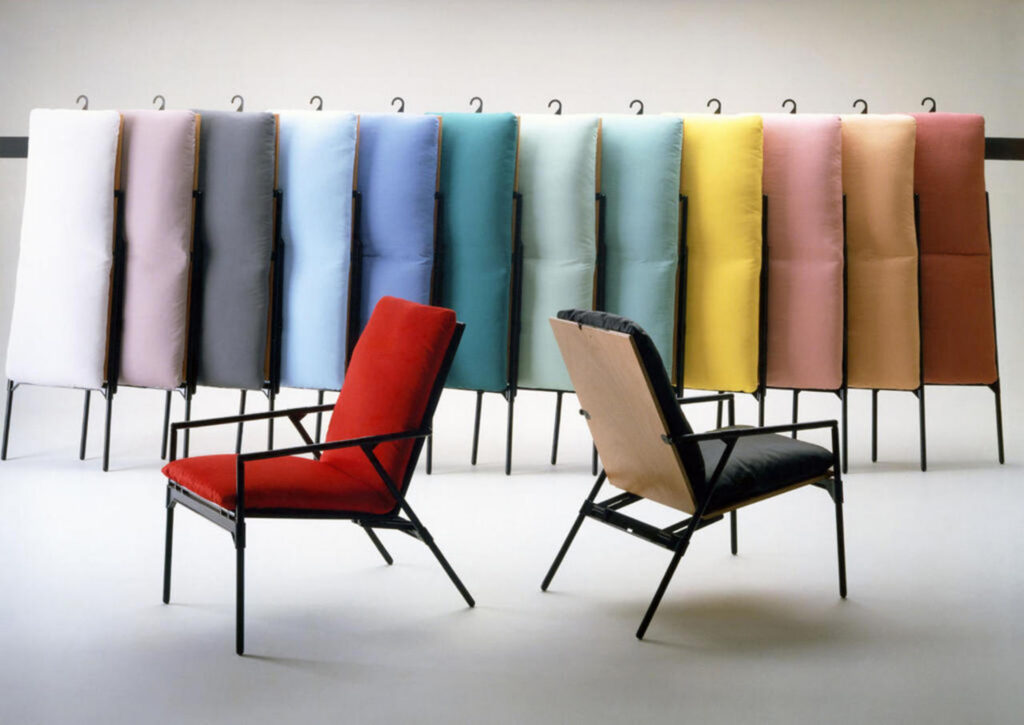
Vincent Van Duysen’s new outdoor seating system was among the key launches, exploring the relationship between structure and comfort through a visible solid wood frame and soft, generous cushions. As a whole, the presentation balanced heritage and renewal, showing B&B Italia’s ability to revisit its archive while continuing to expand the language of contemporary living.
Cosentino x Tom Dixon
Cosentino and Tom Dixon presented AXIS at Fuorisalone 2026, an immersive installation inside Casa Manzoni that explored the relationship between material innovation, structure and spatial experience. Conceived as a progressive journey through five environments, AXIS moved from sculptural table landscapes to architectural applications and atmospheric rooms shaped by light, reflection and sound.
The installation served as the setting for the AXIS table collection, developed in collaboration with ACTIU, while also introducing ĒCLOS, Cosentino’s new mineral surface made with INLAYR technology. With a fully integrated 3D body design, zero crystalline silica and a high recycled content, ĒCLOS positioned surface design as both technical and sensory. The installation also showcased the Dekton Artik Nodes collection.
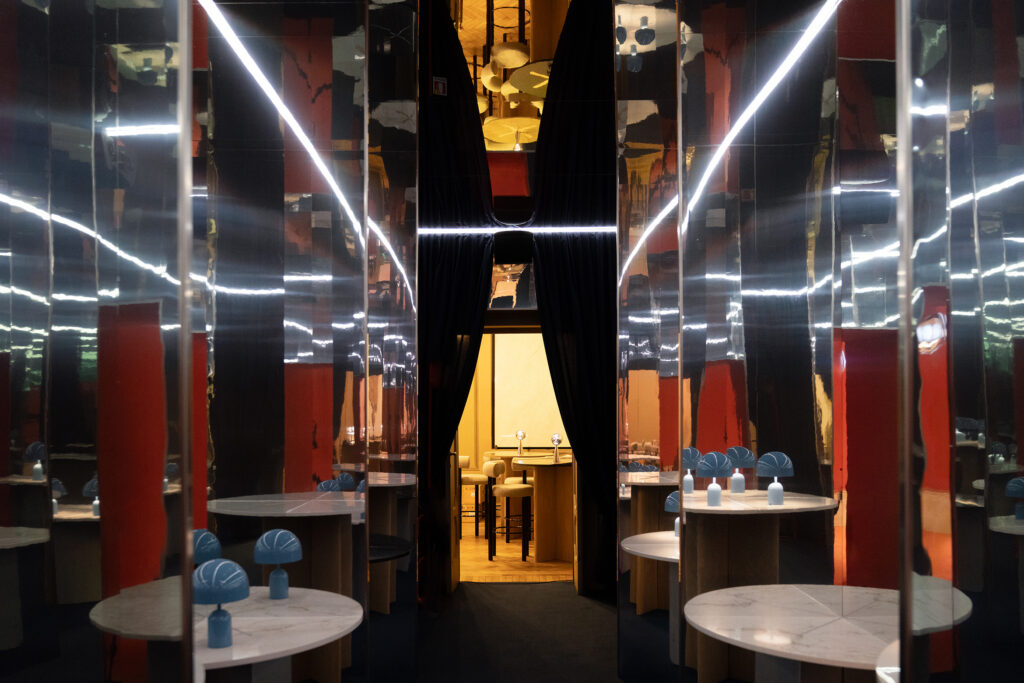
Tom Dixon’s involvement brought a theatrical and experimental edge to the presentation. Known for his fascination with materials, industrial processes and sculptural form, Dixon approached Cosentino’s surfaces not as passive finishes, but as active elements capable of shaping perception. In AXIS, surface became structure, table, architecture and atmosphere at once.
Poltrona Frau
Poltrona Frau’s 2026 collection, True Over Time, centred on the idea of design that preserves meaning across generations. Rather than chasing novelty, the collection looked at longevity, identity and the emotional value of objects intended to be lived with, passed down and reinterpreted without losing their character.
Key launches included the Archibald Sofa System by Jean-Marie Massaud, which evolves one of the brand’s most recognisable armchairs into a modular sofa designed for comfort and changing lifestyles. Ludovica Serafini and Roberto Palomba’s Blisscape sofa was expanded with new seating depths and elements, while Faye Toogood brought her LieLow language into the bedroom for the first time through a new bed and nightstands.
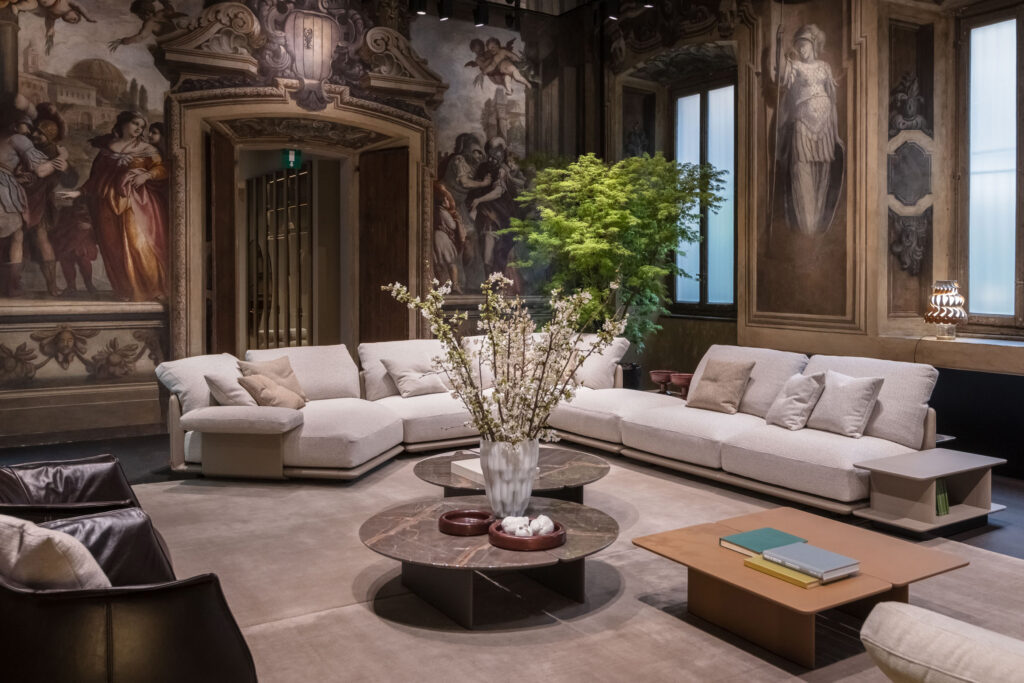
Other additions extended the collection across living, dining and storage. Sebastian Herkner’s Stock N’ Roll gained a refined vanity desk, Dante Bonuccelli’s DomusCove brought the DressCove wardrobe system into the living area, and Roberto Lazzeroni presented the Infinitamente 2.0 table with sculptural Pelle Frau legs, alongside the Abigail table and Zabriskie storage units. With new collaborations and special editions, including the Albero GFF 100 bookcase and Archibald Delicate Balance Limited Edition with Shepard Fairey, Poltrona Frau framed endurance not as stillness, but as continuous renewal.
2026 Salone del Mobile
The post appeared first on .
Related Posts