A 91,454 sq. ft. Design & Build GCC in Bangalore, Rolls-Royce’s largest engineering hub in the world, designed to unify three distinct business units, attract exceptional engineering talent, and position India as a strategic innovation centre for a global aerospace and defence leader.
When Rolls-Royce designated Bangalore as its largest engineering hub in the world, the building that would house that designation had to do more than accommodate the scale. It had to justify it – spatially, culturally, and strategically. A facility that is home to digital engineering, defence technology, and enterprise services isn’t just a large office. It is an argument, in built form, that India is where Rolls-Royce does its most serious thinking.
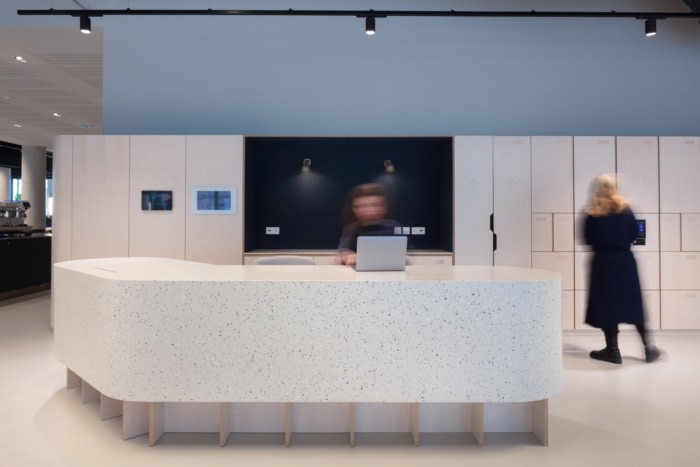
The arrival makes that argument before a word is spoken. The reception doesn’t announce scale, it establishes intent. Sophisticated, warm, and unhurried, it signals an organisation that holds technical excellence and its people with equal seriousness. For engineering talent weighing Rolls-Royce Bangalore against every other option in one of the world’s most competitive markets, the first thirty seconds matter. The building knows this.
Movement through the floor is designed to do cognitive work. Transition zones between functions carry industrial material cues and progressive brand colour – magenta, blue, turquoise – building momentum between disciplines and preparing people for the mode of thinking ahead. This matters because the shift between deep engineering focus and cross-disciplinary collaboration is one of the hardest transitions in knowledge work. At Rolls-Royce Bangalore, where that transition happens dozens of times a day across three distinct disciplines, the building takes on some of that load.
The floor plate is organised into colour-coded functional neighbourhoods – digital engineering, defence, and power systems each with their own spatial identity and palette register. Magenta energises open workspaces, driving the interaction a high-velocity engineering team demands. Blue governs collaborative zones, producing the calm that high-stakes technical problem-solving requires. Turquoise occupies the territory between – balancing creative exchange and cognitive reset. A neutral base of whites and greys holds the system coherent without flattening the distinctions between disciplines. This is not aesthetic colour. It is three business units being given equal spatial dignity within a single innovation ecosystem – a built acknowledgement that what Rolls-Royce Bangalore produces will come from the intersections, not the silos.
Collaborative infrastructure is embedded within each neighbourhood rather than consolidated at the perimeter. Cross-team exchange becomes a feature of daily movement, not a logistical event that requires a meeting room booking to trigger. Because at the world’s largest Rolls-Royce engineering hub, the most valuable thinking is likely to happen between disciplines, not within them.
At the geometric centre of the floor, the cafeteria is the one space where the colour-coding intentionally dissolves. Digital engineers, defence specialists, and enterprise services teams share the same table without hierarchy or agenda. It is not incidental that this space sits at the heart of the building. Informal networks – the connective tissue of genuine innovation – don’t get built in scheduled collaboration rooms. They get built here, over lunch, in the in-between moments the building was designed to make possible.
Rolls-Royce didn’t designate Bangalore its largest engineering hub because of the square footage. It did so because of what it believed this place could produce. The design’s job was to make that belief architecturally legible, in every transition, every neighborhood, every moment where three disciplines that don’t naturally occupy the same register are brought into productive proximity. At 91,454 sq. ft., the building is significant. What makes it worth the attention is what it was built to do with that significance.
Design:
Photography: Courtesy of Space Matrix
The post appeared first on .
Related Posts