Winning the war for talent. How do you design an office so compelling that a predominantly remote tech team actually wants to commute? For Sopra Steria Polska, the ambition was clear: abandon outdated corporate layouts and build one of the most attractive IT workplaces in the country to actively attract and retain top talent. Instead of forcing a return to the office, we turned to deep behavioural research to understand what the team truly missed. We completely shattered the “dark IT” stereotypes, looking instead to local heritage. By interweaving Katowice’s modernist architecture with geological metaphors and Silesian culture, we designed a timeless, magnetic ecosystem. It is a space that doesn’t just support hybrid work — it elevates it, balancing deep focus with a profound sense of belonging.
The hybrid challenge and real estate strategy
For years, Sopra Steria operated from an older Katowice office that no longer reflected the expectations of a modern technology organisation. To strengthen its competitiveness in the fierce IT talent market, the company set out to build a highly attractive, future-proof workplace.
With an organisation of over 1,000 employees, the strategic challenge was mathematical as well as architectural: how large should the new office actually be? To ensure the foundation was perfect, our role began long before the lease was signed. Our comprehensive scope spanned the entire process, starting with real estate advisory and test fits, moving through workplace strategy and space planning, and culminating in the final design concept and environmental branding. We actively guided the real estate strategy to help the client select the absolute optimal site: the Grundmanna Office Park.
Data-driven insights
Before drawing any plans, we launched an intensive, multi-layered workplace strategy phase. To ensure our design was rooted in actual needs, our research scale was massive: we surveyed 693 employees, conducted 14 in-depth leadership interviews, and hosted co-creative workshops with 22 departmental representatives. The data confirmed a massive shift: over 90% of employees preferred working from home, and 69% wanted to visit the office no more than twice a month.
Through visual moodboard testing, the team completely rejected the stereotype of a dark, “scenographic” tech environment. Instead, they demanded bright, warm, and natural spaces rich in greenery and welcoming materials. The research also revealed that when employees did visit the office, they primarily needed superior acoustic comfort for deep focus work, alongside vibrant spaces for social integration and mental regeneration.
The activity-based ecosystem
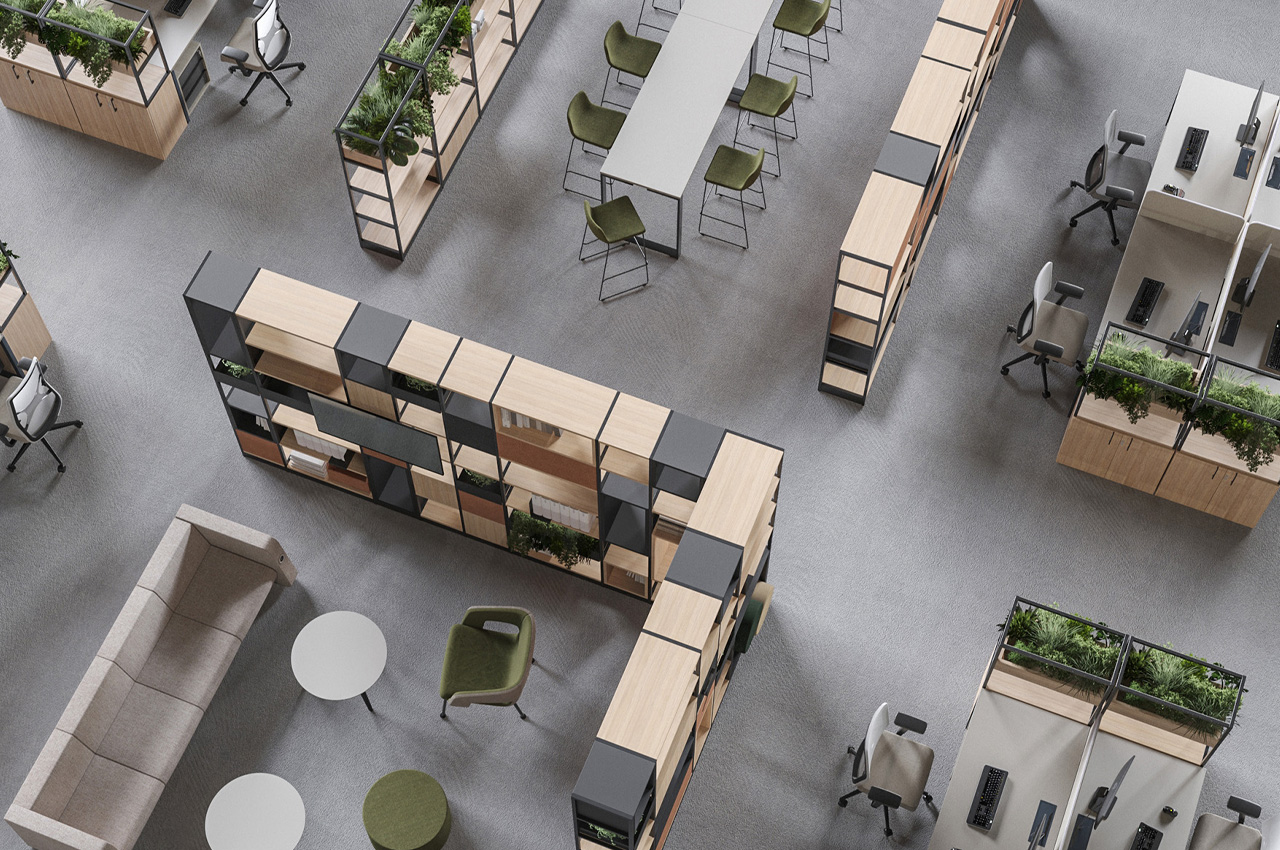
To translate insights from our research into a physical layout, we developed an activity-based spatial program that optimised the footprint without sacrificing comfort. We designed a highly efficient model featuring 300 workstations capable of seamlessly supporting the 1,000+ person hybrid team.
The heart of the office
A large social and networking area forms the vibrant heart of the workplace. Designed with extreme adaptability in mind, this space utilises flexible furniture and movable partitions. In minutes, it can effortlessly transform from a casual daily dining and networking area into a massive townhall venue, perfectly equipped for large company gatherings, workshops, and internal events.
The client suite
To support external business relationships, we designed a dedicated premium client meeting suite. Acting as a highly representative space for visitors, this zone elevates the professional experience, offering a refined, comfortable, and visually striking environment tailored specifically for hosting key partners and clients.
Neighbourhoods of focus
The workplace was strategically structured into modular team zones, typically accommodating 10–16 workstations. To answer the demand for acoustic comfort and collaboration, the layout features an ecosystem of over forty collaboration spaces, including diverse meeting rooms and focus rooms, immediately supporting each neighbourhood. This modular approach ensures the office can effortlessly adapt as the company’s team structures and work patterns continue to evolve.
Design:
Photography:
The post appeared first on .
Related Posts