As Sydney Design 2025 gets underway, two major award-winners have been announced by . First, the $10,000 Holdmark Innovation Award has been awarded to architecture firm . Second, industrial designer Olson Hamilton-Smith has been named the recipient of the Carl Nielsen Design Accelerator program for his project FOLDEE.
Presented by Powerhouse and supported by Principal Partner Holdmark Property Group, the annual Holdmark Innovation Award recognises excellence and innovation in the built environment. This year’s selection committee included Youssofzay Hart Co-Director Belqis Youssofzay, Powerhouse Senior Exhibition Curator Keinton Butler, Holdmark Property Group Chief Operating Officer Kevin Nassif, Government Architect NSW Director of Design Excellence Olivia Hyde and Western Sydney University’s Lang Walker Endowed Chair in Urban Transformation Professor Greg Morrison.
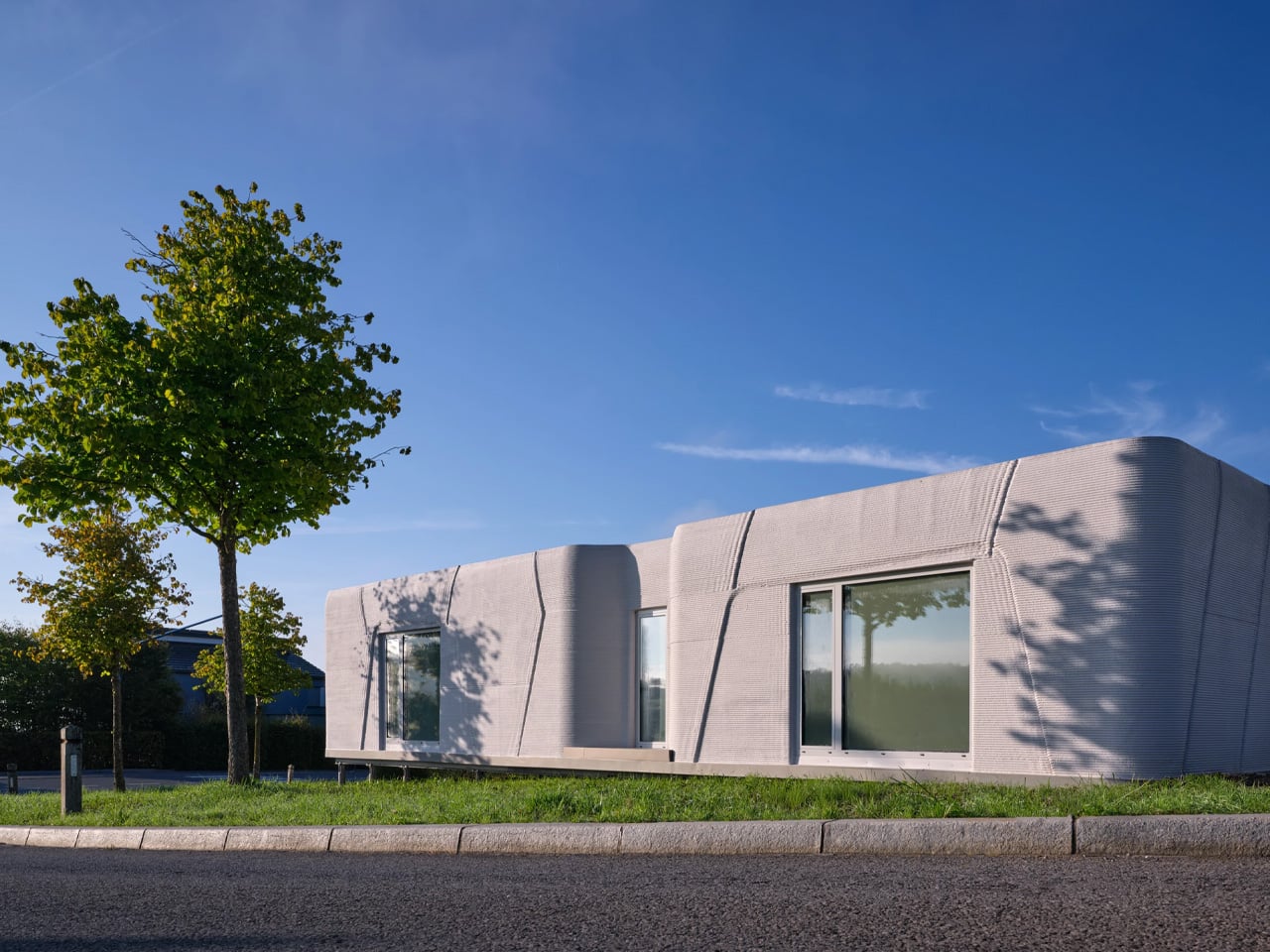
Hassell’s First Building is a collaborative space for government, industry and research to incubate innovative manufacturing projects. It is the first completed building in , Australia’s first new city in a century. Designed and built using circular economy principles, the project prioritises sustainability. Conceived as a ‘kit of parts,’ the building minimises waste and allows for flexible adaptation, repurposing, relocation or disassembly – setting a new benchmark for sustainable urban development.
First Building – housing Stage 1 of the Advanced Manufacturing Readiness Facility (AMRF) – offers shared facilities with cutting-edge technology, training and networks to drive innovation in Bradfield. Its construction had a significant social and economic impact including over $12 million spent with local Western Sydney businesses and more than $3.5 million with businesses.
“First Building demonstrates how community design and industry can move together: a Country-centred approach, powered by advanced manufacturing and designed for disassembly,” says Kevin Nassif, Chief Operating Officer, Holdmark Property Group. “It demonstrates a circular, low-carbon path that creates skilled jobs and new enterprise in Western Sydney.”
Managing Director Liz Westgarth comments: “As architects, designing the first building in a new city is both a profound responsibility and a rare opportunity to leave a lasting legacy. We are proud to have created a building that directly responds to the challenges of our climate and our urban environment. The First Building provides more than a place for people to work and innovate – it sets a benchmark. It demonstrates that new cities can be imagined and built differently: with sustainability, adaptability and community at their core. Most importantly, it sets out a vision for the kind of future we want to create.”
Related:
Meanwhile, the Carl Nielsen Design Accelerator – supported by a bequest from Carl and Judy Nielsen – is an annual Powerhouse program recognising outstanding sustainable industrial design. It offers an emerging Australian designer a tailor-made, nine-month residency to develop a product, guided by Industrial Designer and Founder of IDX SYD Ed Ko. The selection panel comprised of Ko, Powerhouse Curator Angelique Hutchison and Nielsen Design Associates Director Adam Laws.
Hamilton-Smith’s project, FOLDEE, is Australia’s first locally designed and manufactured folding cargo bike. Easier to transport and store than traditional bicycles, FOLDEE promotes cycling as a low-emissions transport option. Designed and built in Melbourne by an interdisciplinary team, the bike features a double-hinge folding mechanism and uses 100 per cent recyclable steel for compact, sustainable design and storage.
“Olson’s project is in a relatively small but growing area of a highly competitive market,” says Nielsen Design Associates Director Adam Laws. “Its time is now, with low impact environmental solutions being encouraged and sought after.”
Industrial Designer and Founder of IDX SYD Ed Ko adds: “What excites me about FOLDEE is how it illuminates another boundary of modern Australian industrial design practice, where the designer is as much maker, fabricator and engineer. Olson and FOLDEE continues an industry-induced response to industrial design that stretches back to Breuer’s Bauhaus experiments with bicycle frame technology. Through FOLDEE, we see once again how the humble bicycle becomes a lens for exploring integration of advanced manufacturing technologies and evolving sustainable practice, reminding us that good industrial design is best when it cares deeply about the technical as well as the social.”
Carl Nielsen Design Accelerator recipient Olson Hamilton-Smith comments: “Through the Carl Nielsen Design Accelerator I’m looking to explore how advanced manufacturing technologies and construction processes can be used to further resolve the FOLDEE’s aesthetic, improve the engineered performance and streamline local production to bring a higher quality item to market.”
Sydney Design Week
Photography
Mark Syke, Vinchy Wu, Andy Roberts
The post appeared first on .
Related Posts