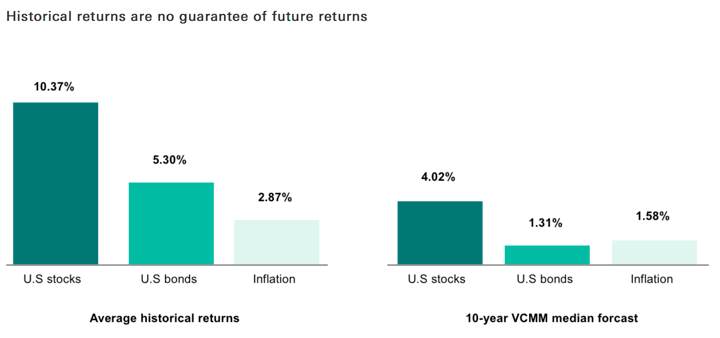
Vanguard Research has published a new whitepaper titled , which discusses its assumptions and how different factors can hurt or improve your odds of success. Many of these topics have been discussed at length elsewhere, but as always I appreciate the power of concise definitions and simple charts to help with understanding.
Here is a nice, concise definition for FIRE:
FIRE stands for “Financial Independence Retire Early.” FIRE investors save as much of their income as possible during their working years, hoping to attain financial independence at a young age and maintain it through the rest of their life—aka retirement.
Here is a nice, concise history of the 4% Rule:
Bengen (1994) calculated the maximum percentage that retirees could withdraw annually from their portfolio without running out of money over 30 years. Advisors refer to this percentage as the safe withdrawal rate. Bengen summarized his findings as follows: “Assuming a minimum requirement of 30 years of portfolio longevity, a first-year withdrawal rate of 4 percent, followed by inflation-adjusted withdrawals in subsequent years, should be safe.” And the 4% rule was born.
Here are the potential issues with the assumptions embedded within the 4% rule:
- The use of historical returns as a guide for future returns
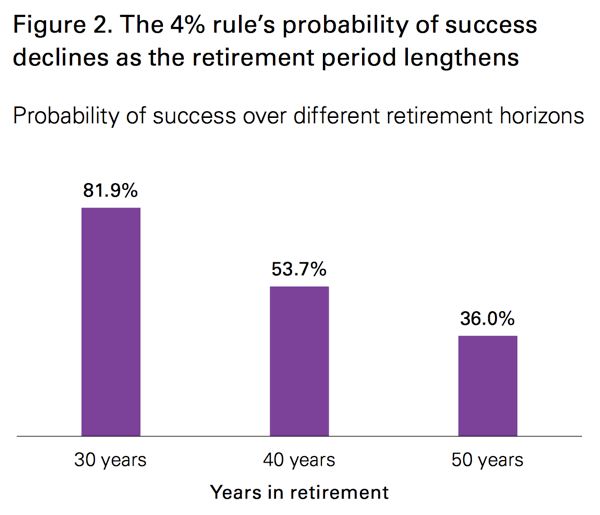
- A retirement horizon of 30 years
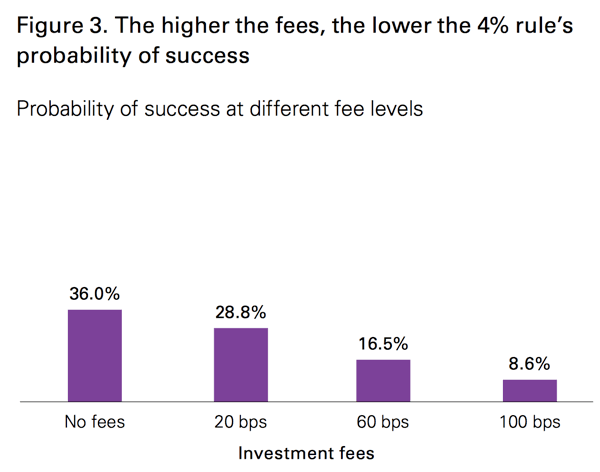
- Returns equal to those of market indexes, without accounting for fees
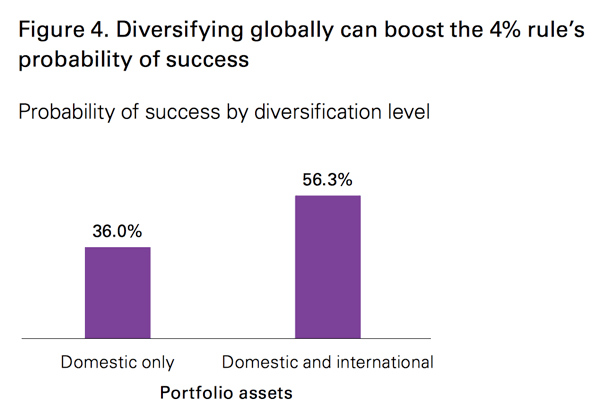
- A portfolio invested only in domestic assets (“home bias”)
- A fixed percentage withdrawal in real terms (“dollar plus inflation”)
Here are suggested adjustments. Additional, helpful details are in the paper.
Don’t assume historical averages will hold for the future. Vanguard calculates their own forward-looking estimates based on factors like stock P/E ratios, current bond interest rates, and recent inflation statistics. They are a lot lower than historical averages, as seen in the graphic above (at the top of this post).
Understand that your retirement horizon may be much longer than 30 years. The longer a portfolio has to last, the more likely it can fail.
Minimize costs. Advisor fees, mutual fund and ETF fees, taxes, and other fees will cut directly into your net income. 1% in investment fees makes a big impact.
Invest in a diversified portfolio. Vanguard believes that adding some international assets will improve your chances of success. Right now, international stocks have lower valuations (P/E and related) as compared to US stocks.
Use a dynamic spending strategy. As you can see below, this is one of the most powerful ways to improve your odds of success. If you can spend less during a bear market (while also getting to spend more in a bull market), your portfolio’s chances of survival improve dramatically. Either your budget has enough “padding” such that cutting back won’t hurt much, or it hurts but you are willing to endure that temporary pain, or you maintain the option to work a little to earn some additional income if needed.
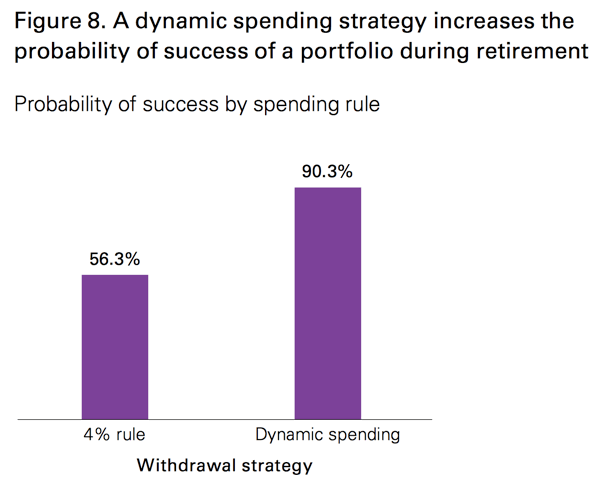
Vanguard doesn’t give any hard numbers when it comes to replacing the 4% number, but the lower expected future returns, longer time horizon, and fee impact all point to a lower number. However, being flexible with your portfolio withdrawals can raise the number.
I enjoy thinking about these sorts of variables and ways to optimize, but the fact is that nobody knows the future “safe” withdrawal rate, even within a percentage point. You have to let go of the idea of 100% certainty. Planning for flexibility (identifying areas to cut back temporarily, maintaining backup work options) and having belief in your ability to adapt is critical for pulling off FIRE at any reasonable withdrawal rate (say 3% to 4%). FIRE is about balancing the fear of running out of money with the .
“The editorial content here is not provided by any of the companies mentioned, and has not been reviewed, approved or otherwise endorsed by any of these entities. Opinions expressed here are the author’s alone. This email may contain links through which we are compensated when you click on or are approved for offers.”
from .
Copyright © 2004-2021 MyMoneyBlog.com. All Rights Reserved. Do not re-syndicate without permission.
Related Posts