Running from 20 May to 26 November, this years Venice Architecture Biennale features the Singapore installation entitled “WHEN IS ENOUGH, ENOUGH? The Performance of Measurement”. It’s curated by Singapore Institute of Architects President Ar. Melvin Tan, with council member and architect extraordinaire Ar. Adrian Lai, whose work includes Khong Guan Building (with Meta, 2018), Gardens by the Bay in , Bridge Learning Campus in Bristol, and Guangzhou International Finance Centre in (with Wilkinson Eyre, 2005-2012). They are joined by fellow council member Ar. Wong Ker How, founding partner of ASOLIDPLAN and superstar of contemporary residential Singaporean architecture.
The pavilion aims to open up dialogue about new ways of measuring and evaluating the intangibles we design to – attributes such as agency, attachment, attraction, connection, freedom, and inclusion – and asks in particular: how much is enough?

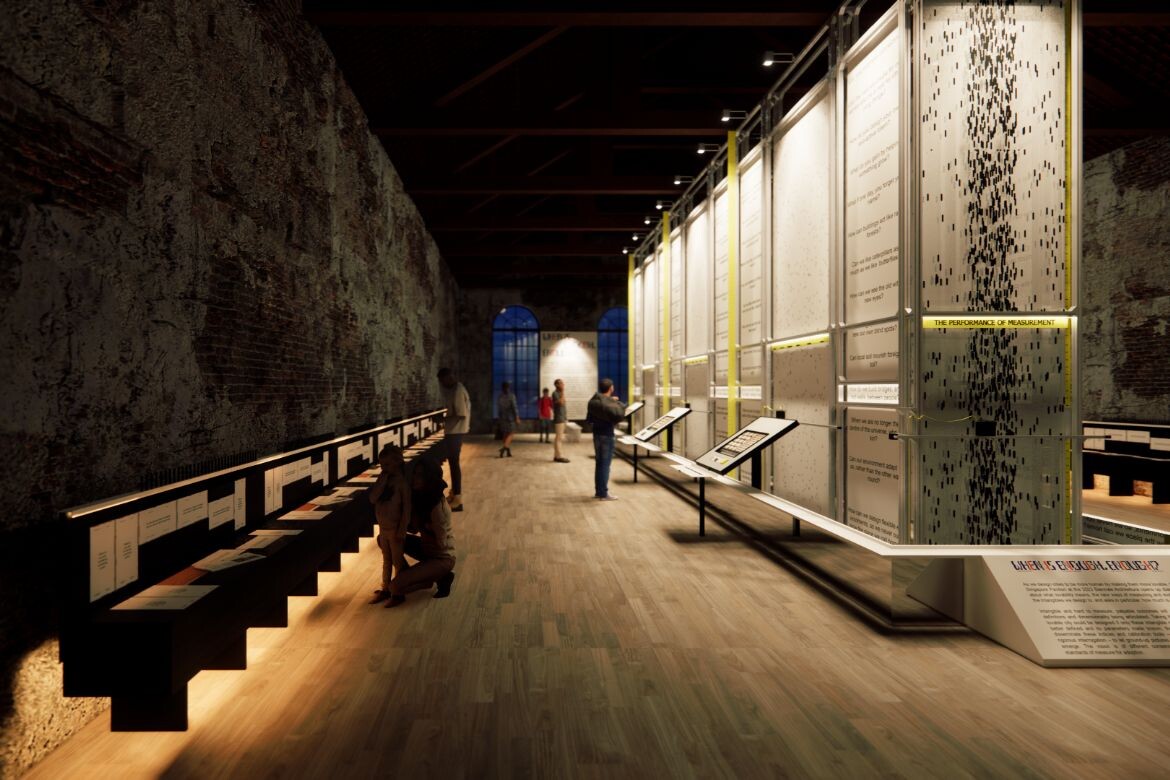
Taking the premise established by Louis Kahn — “a great building, in my opinion, must begin with the unmeasurable, go through measurable means when it is being designed, and in the end must be unmeasurable” — the curators have devised the centrepiece of the pavilion as a Values Measurement Machine. Comprising a spectacular series of analogue plotting devices that mark data on 5-metre tall calligraphic scrolls, which are constantly in motion, the machine asks the question. In building a lovable city, how do we measure the unmeasurable — agency, attachment, attraction, connection, freedom, inclusion?
To help answer, visitors to the are invited to respond to six questions around the intangible elements of the and reflect on the qualities that can transform the urban landscape beyond a human-orientated city to a worldly, lovable one. Navigating through a spectrum of artistic renders, visitors will pinpoint the critical balance of qualities to evoke their desired habitat, weighing up their preferences and registering these values.
Related:
that aim to pinpoint the qualities that transform the urban landscape beyond a
human-oriented, loveable city. These questions cover the fields of design for
dementia and neurodiversity, rewilding, biodiversity, nutrition, and biomimicry
ecosystems.
This act of weighing and registering values will form the body of the artwork, with the collected data plotted on the large calligraphic scrolls, in a real-time display of consensus and contradiction that takes place over the six months of the Biennale Architettura 2023.
Accompanying the machine are exhibits containing 41 other questions. Each of these invite visitors to pause and learn more about the research of architectural practices involved in the pavilion. Their work on measuring intangibles, while designing for issues such as dementia and , rewilding, biodiversity, nutrition, and biomimicry ecosystems will form the focus of these explorations.

a spectrum of artistic renders that best represent their responses. Their preferences
will be plotted on the giant rolling scrolls, in a real-time display of consensus and
contradiction.
The set of exhibits and questions was created in collaboration with architects and researchers whose practices deal with agency, attachment, attraction, connection, freedom in the city and inclusion. In examining design processes that work for these six goals, the Singapore Pavilion uncovers challenges and contradictions, and brings to light methods of addressing diverse preferences and the conundrums that arise.
The 2023 Singapore Pavilion was co-commissioned by the Urban Redevelopment Authority (URA) and the DesignSingapore Council (Dsg), and organised by the Singapore Institute of Architects (SIA).
Venezia Biennale Architettura 2023
Urban Redevelopment Authority
Design Singapore Council
Singapore Institute of Architects
The post appeared first on .
Related Posts