Last week, employees at several A.I. companies , saying that rapidly evolving machine learning systems could lead to human extinction by 2030. A few days later, the Toronto International Film Festival screened , the latest movie from French playwright-turned–film director Florian Zeller, starring real-life couple Penélope Cruz and Javier Bardem. Who can say what will eventually spark the apocalypse — another pandemic, nuclear warfare and social revolt are a few scenarios floated in Bunker. But whatever catastrophe we face next, those with unlimited means are keen on surviving it in as comfortable an environment as possible — Zeller says he was inspired to make Bunker by .
In the film, Bardem portrays Miguel Moreno, a starchitect approached to envision a subterranean hideout for a tech billionaire, Andrew, played by Paul Dano. (Note: This review contains light spoilers.) Miguel’s wife, Sofia (Cruz), hates the idea, pointing out that Andrew is the same person behind the toxic phone app that is rotting their daughter’s brain. Miguel’s business partner, on the other hand, describes the bunker project as a rare opportunity to create something “pharaonic.” Inspired by this exchange, Bardem develops a concept shaped like an inverted pyramid. This design gets at Bunker’s biggest weakness — its heavy-handedness. But its performances are solid and its premise raises timely questions about those operating in the design profession’s upper echelons.
Miguel frequently defends the bunker project to his wife as an intriguing “technical challenge” and a rare chance to create something “huge.” Sofia (a literary agent) has watched him spend years choosing his work over her in relentless pursuit of the RIBA Stirling Prize, which Miguel believed would finally garner him commissions for the “hospitals and opera houses” he had always wanted to design. Now that he’s won it, he is instead being courted by a very different type of client. His increasing ambition has led him to a point where satisfying projects exist at a scale that can only be financed by morally corrupt billionaires.
As Miguel weighs the moral implications of helping to shelter Andrew from the very world he is actively destroying, the Morenos confront their own class comforts. Next door, their new neighbour, Tony, is seeking to convert a garage into a living space by adding a window that would look into the Morenos’ garden. Shortly after Miguel threatens to sue Tony, the Morenos’ cat goes missing. Miguel’s work with Andrew heightens his already escalating paranoia. He explores new forms of home security — smoke canisters that detonate upon detecting intruders — just as Andrew requests even more extreme measures for his upcoming safe house, like “oxygen renewal systems tied to voice recognition.” (Now that I have heard this phrase, I will absolutely never forget it.)
Miguel initially balks at Andrew’s requests: he is used to designing the “houses of people’s dreams” and this feels closer to a “house of your nightmares.” But Miguel’s own standoff with his neighbour demonstrates that the two have more in common than he’d like to admit. With great wealth comes great mistrust of others.

In the end, the film is most effective at demonstrating the tensions that accompany architectural fame and fortune. While the design industry was once filled with household names, architects with serious star power have become a rarer breed in recent decades. Bunker suggests that’s a good thing. The higher your profile, the more likely you are to be catering to a rarefied crowd that is increasingly detached from reality — or worse. In the spring, The Architect’s Newspaper took inventory of who turned up in the Epstein emails.
Of course, it is possible to win the RIBA Stirling Prize — or the Pritzker — without losing sight of social values. Earlier this month, as Bunker was playing at the Venice Film Festival, Wim Wenders premiered a Brad Pitt–produced documentary about Peter Zumthor. The doc arrives hot on the heels of this spring’s opening of the David Geffen Galleries at LACMA — a spectacular display of art with a generous public plaza that serves far more than just an elite few. Mind you, it’s also named after a billionaire, and its California location means that it’s sure to put Zumthor on the radar of any tech founders who weren’t already familiar with his work. The Swiss Pritzker winner may be a notoriously reclusive presence — but what better personality to design a bunker?
Ultimately, thanks to the magic of NDAs (which turn up frequently in Bunker), we can’t know which of today’s starchitects are working to shelter the billionaires among us when the rest of us perish. But Bunker does a convincing job of exploring what goes through a seemingly socially minded designer’s head when presented with that type of opportunity. In a bit of a cop-out, Miguel’s choice is ultimately made for him by another of the movie’s heavy-handed moments. But the overall implications are clear: a job is never just a job, or a “technical challenge.”
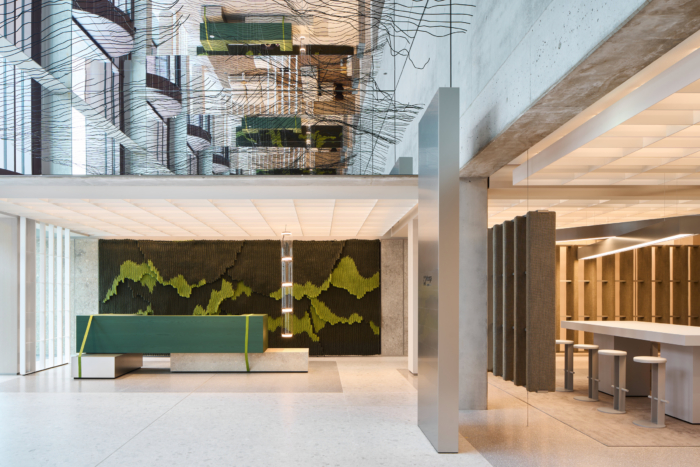
Afterwards, in an onstage Q&A with TIFF CEO Cameron Bailey, Bardem and Zeller revealed that the Morenos’ London house — a modern cinematic marvel in concrete and glass, filled with an enviable collection of Flos lamps and Alessi kitchen accessories — was actually built on a soundstage in Madrid. Zeller had wanted to set the film in London to present the Madrid-born Morenos as particularly urbane and international. During an early interview scene, Miguel tells a journalist that he is a “New Yorker in New York, a Berliner in Berlin and a Londoner in London” — demonstrating that being a so-called global citizen is more important to him than being someone with a strong connection to his own neighbours. His words also reflect the ethos of modern architecture, especially the International Style, which believed that a designer could helicopter into any setting and apply the same consistent aesthetic.
Bardem and Cruz could not be more unlike their characters in that way: Onstage, Bardem said that, for him and his wife, a key part of the project’s appeal was that, even though the story is set in London, they could shoot it at home in Madrid without having to leave their kids and community. One of the best scenes in Bunker sees Miguel comforting his daughter about their missing cat. As the tech industry loses sight of humanity, it’s important that architecture doesn’t follow suit.
Bunker will play in theatres later this year.
The post appeared first on .
Related Posts