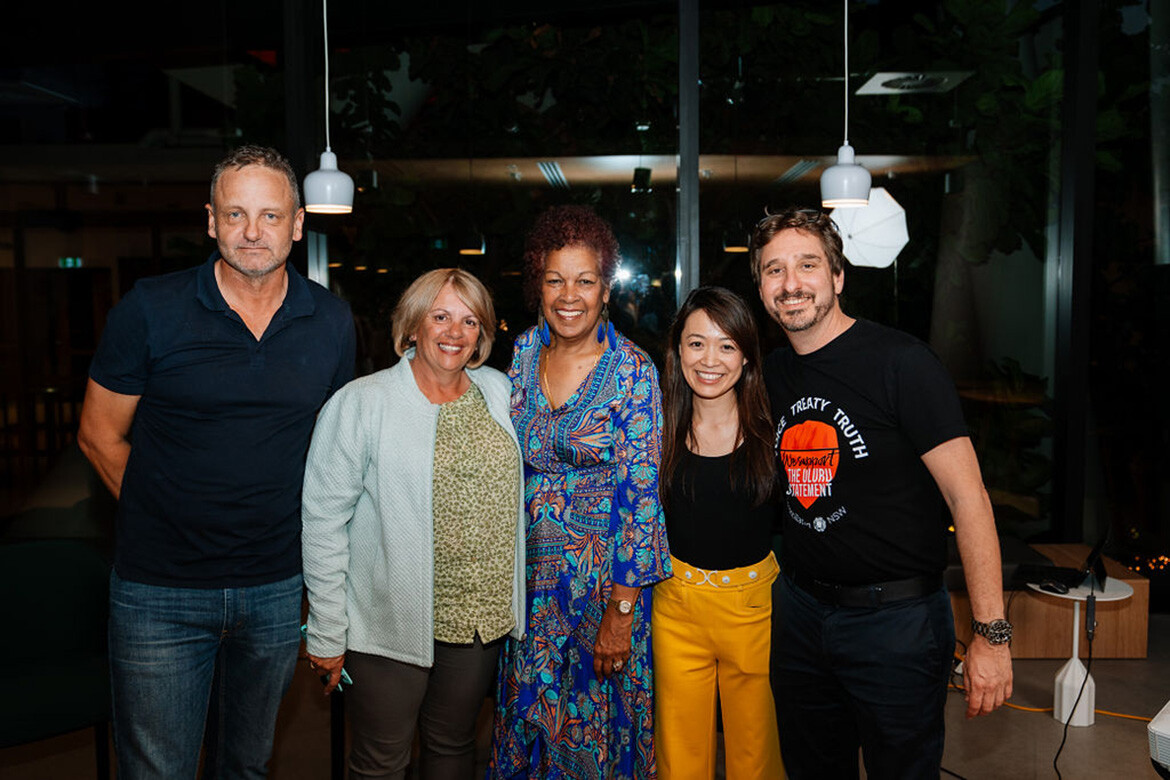
The professional design world doesn’t always allow for time to reflect on the past. Events such as ‘The Modern House is History’, held at the in Sydney in November, provide an opportunity for those in the architecture community to come together and orient themselves in relation to history and the present. Although cut dramatically short when an audience member fell ill – and we sincerely wish her well – the event invited consideration of a number of important issues including the social role of architecture, connection to place and the experimental fringe.
With Richard Leplastrier as guest speaker alongside academics Catherine Lassen and Cameron Logan, the focal point for the panel discussion was Jennifer Taylor’s 1972 book, ‘An Australia Identity: Houses for Sydney 1953-63’. Orientation here, then, begins by historicising the question of housing accessibility in Sydney – creating new perspectives on what a house can be and what housing is for.

Today, the image of an architecturally designed house on Sydney’s North Shore might seem highly exclusive and boutique. However, as Lassen explained: “At that time, the ambition of the relationship between well-designed houses and hous-ing was integrated; these architects considered the custom design of individual houses in close connection to the larger scale problem of housing.”
Logan explains further: “It’s also about the cost of land. Architects using innovative approaches to materials and the design process is not going to address the housing affordability problem in Sydney. That’s not to say that architects have no role to play but the sort of experiment that was underway in the post-war decades was based on relatively affordable land and rethinking the house in that context.”
Related:

This is one example of why historicising architectural concerns is so important for present and future practice. If we can understand the experimental dimension of work by architects such as Leplastrier by contextualising material issues such as land cost, we might also unlock the radical potential in some of that experimentation in order to address contemporary problems.
Taken together, the panel discussion invited designers to ask: what is it to be socially engaged as an architect, to resist a separation between aesthetics and progressive politics or to read past attempts at doing so against today’s problems?
In the context of Australia and the ‘Sydney School,’ these questions cohere around a fundamental concern: what does it really mean to be architecturally of a place?
“It’s about people in a certain place saying, ‘we think we’re doing something that’s representative of, or connects somehow, to this place,’” explains Logan. “What are the stakes for the city of having something that is the ‘really’ representative architecture?”

These are crucial questions for architects designing today in Sydney. To return to the past, perhaps the defining feature of what David Saunders called the “backward-looking avant-garde” of the ‘Sydney School’ was its emphasis on experimentation. As Lassen says, it’s about “using architecture to raise questions.”
The so-called ‘bandit fringe’ sought to position itself with one foot inside the institutions of architecture and one out. It is, in Logan’s words, “architecture from the fringe, the edge or the margins.”
In concrete terms, for example, this meant using low-cost materials amidst a general atmosphere of experimentation. Referring to his work with Jørn Utzon, such as for the unbuilt Kara Crescent house in Bayview, Leplastrier noted: “they were a humble mob; they took us in.”
What does this all mean for architects today? The event, with sequels planned in 2023, didn’t seek to provide easy answers. If, however, something of the attitude of the bandit fringe can be rekindled, it might go some way towards addressing the issues of the 21st century by creating an avant-garde productively rooted in place and history.
Sydney Open

We think you might also like .
The post appeared first on .
Related Posts