Measure twice, cut once is solid advice that skips a few steps. Somewhere between the measuring and the cutting you also need a pencil, a square, a knife, and usually a level, and they are never in the same place. Every maker knows the shuffle of patting down pockets for a stub of graphite. It is the least glamorous part of any project, and nobody has bothered to design around it. MakerPi did.
The Tiruler 2.0 is a folding ruler from MakerPi in Hong Kong, built from Grade 5 titanium and brass. Its two 3.94-inch (10 cm) arms carry a magnetic pencil, a magnetic knife, a pocket caliper, a curve-measuring wheel, and a bubble level. A row of holes along one arm turns it into a compass, which is a party trick I did not expect from a ruler. The hinge also stops at 45, 90, and 180 degrees. All of it comes to 2.2 ounces (63.3 g), a little more than a large egg.
Designer: MakerPi
$148 (33% off). Hurry, only 215/500 left! Raised over $140,000.
A titanium body with scales you can actually read
Most of the Tiruler 2.0 is Grade 5 titanium, the Ti-6Al-4V alloy aerospace engineers rely on, shaped into two folding arms. Brass scale plates add the warm gold you see against the gray metal. One arm reads metric and the other reads imperial by default, which ends the mental conversion game. All-metric and all-imperial versions are offered for people who live in one system. Titanium also resists corrosion, so a tool that rides in a pocket or a bag should wear well.
The scale markings are now chemically etched and filled with black ink. The original Tiruler laser-engraved its brass scales, and users found some marks hard to read once grime built up. MakerPi made the change after feedback on that first version. The result is crisp, high-contrast numbers that read well from different angles. It is a technique familiar from instrument dials, and I like seeing it on a pocket tool. A ruler you cannot read is a stick.
Angle stops, a curve wheel, and a caliper that reads to 0.1 mm
The pivot end of the Tiruler 2.0 handles angles and curves. A brass dial measures an angle and lets you draw it directly, with stops at 45, 90, and 180 degrees so common corners click into place. The same end works as a measuring wheel, where one full rotation equals 3.94 inches (100 mm). A click sounds each time the wheel passes zero. For anything longer, you count the clicks and add the current reading, which is old-school arithmetic that works fine on a bottle or a bike frame.
The pocket caliper slides out of an arm and reads down to 0.1 mm using a vernier-style scale. Pierre Vernier published that clever scale back in 1631, and it still works the same way. Outside measurements cover cylinders, bottle caps, rings, and model parts. New this generation are inside measurements, taken with two 1.5 mm pins across a range of 0.12 to 2.17 inches (3 to 55 mm). You add 3 mm to the brass scale reading, so 11 mm becomes 14 mm, a small tax that still beats a trip to the toolbox.
A magnetic pencil that doubles as a compass, plus a blade
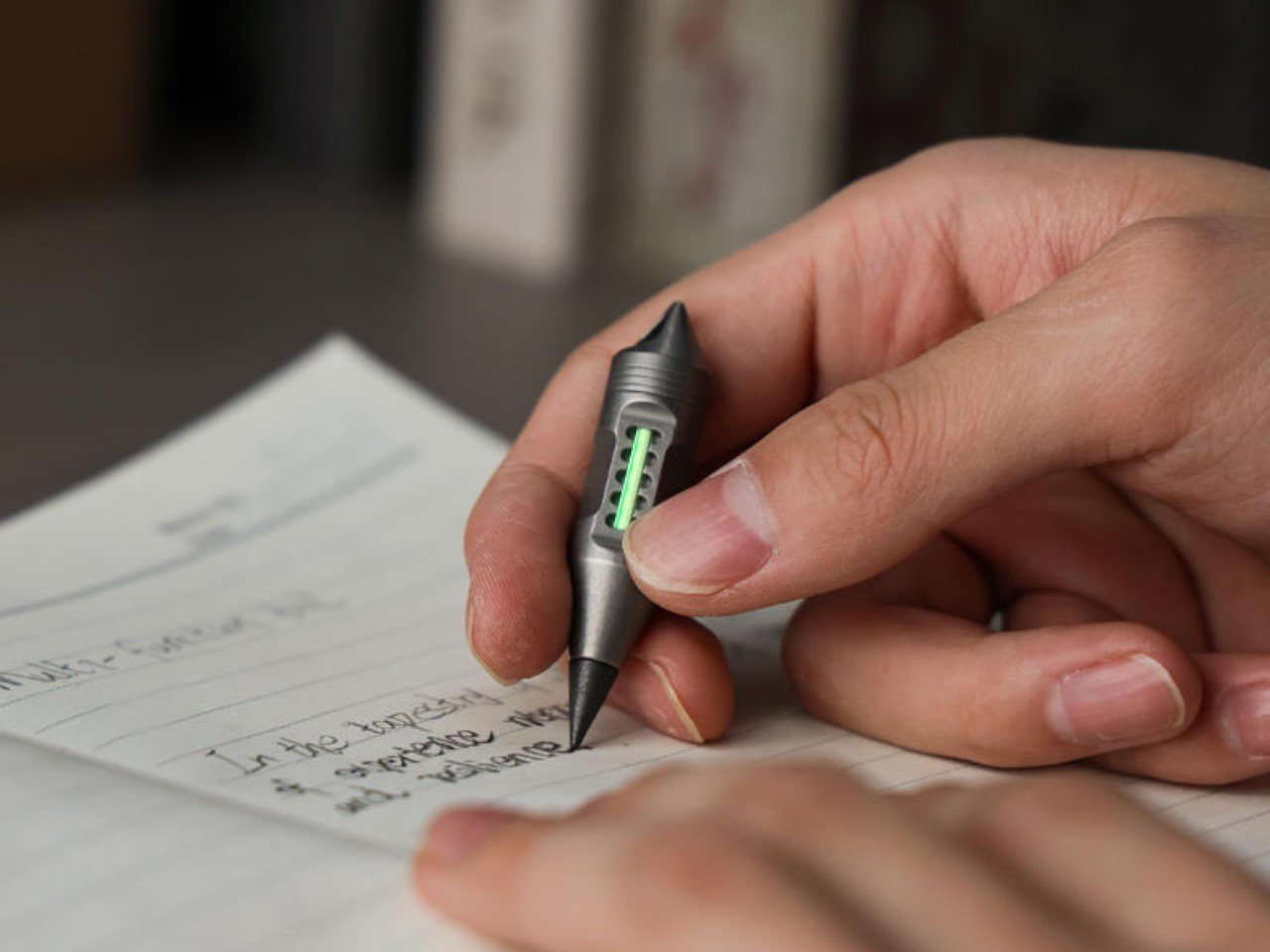
The pencil sits in a magnetic slot and pulls out with no latch to fight. Its replaceable everlasting tip is water-resistant and needs no sharpening. Unscrew the top and a fine pin appears, which works as a SIM ejector, a toothpick, a tiny hole punch, or a pick for small parts. That same pin is the pivot for the compass function. Plant it, drop the pencil into one of the holes along the arm, and rotate the ruler around it, with the scale telling you the circle size. I love it when one small part gets two jobs.
The knife lives in its own magnetic slot, backed by an extra retention feature so it stays put when the tool gets shaken or carried around. It accepts standard #11 scalpel blades, so replacements are cheap and easy to find. Paper, cardstock, and tape are the intended targets. MakerPi says plainly that it does not replace a dedicated cutting tool, which I appreciate. Measuring, marking, and slicing along the same edge without setting anything down is the point.
Glow tubes, engraving, and what it costs
A bubble level is built in, handy for installation, positioning, and model making. Two mounting holes take tritium tubes or glass glow tubes, which makes the tool easy to spot in dim light. Tritium glows continuously without charging, while glass tubes charge under UV light and slowly fade. There is also an optional engraving area that takes up to 20 characters, ideal for a name or a mark. A genuine leather case is available as an add-on for protection and storage.
Early pricing for the Tiruler 2.0 starts at $99, against a planned retail price of $148. The default build pairs a metric arm with an imperial arm, and all-metric or all-imperial versions are available. Each unit includes the magnetic pencil and knife, while the leather case, glow tubes, and custom engraving are optional add-ons. MakerPi ships worldwide and import and export taxes are already baked into the price, so US buyers should not face a customs bill. Shipping is expected to begin in March 2027.
$148 (33% off). Hurry, only 215/500 left! Raised over $140,000.
The post first appeared on .
Related Posts