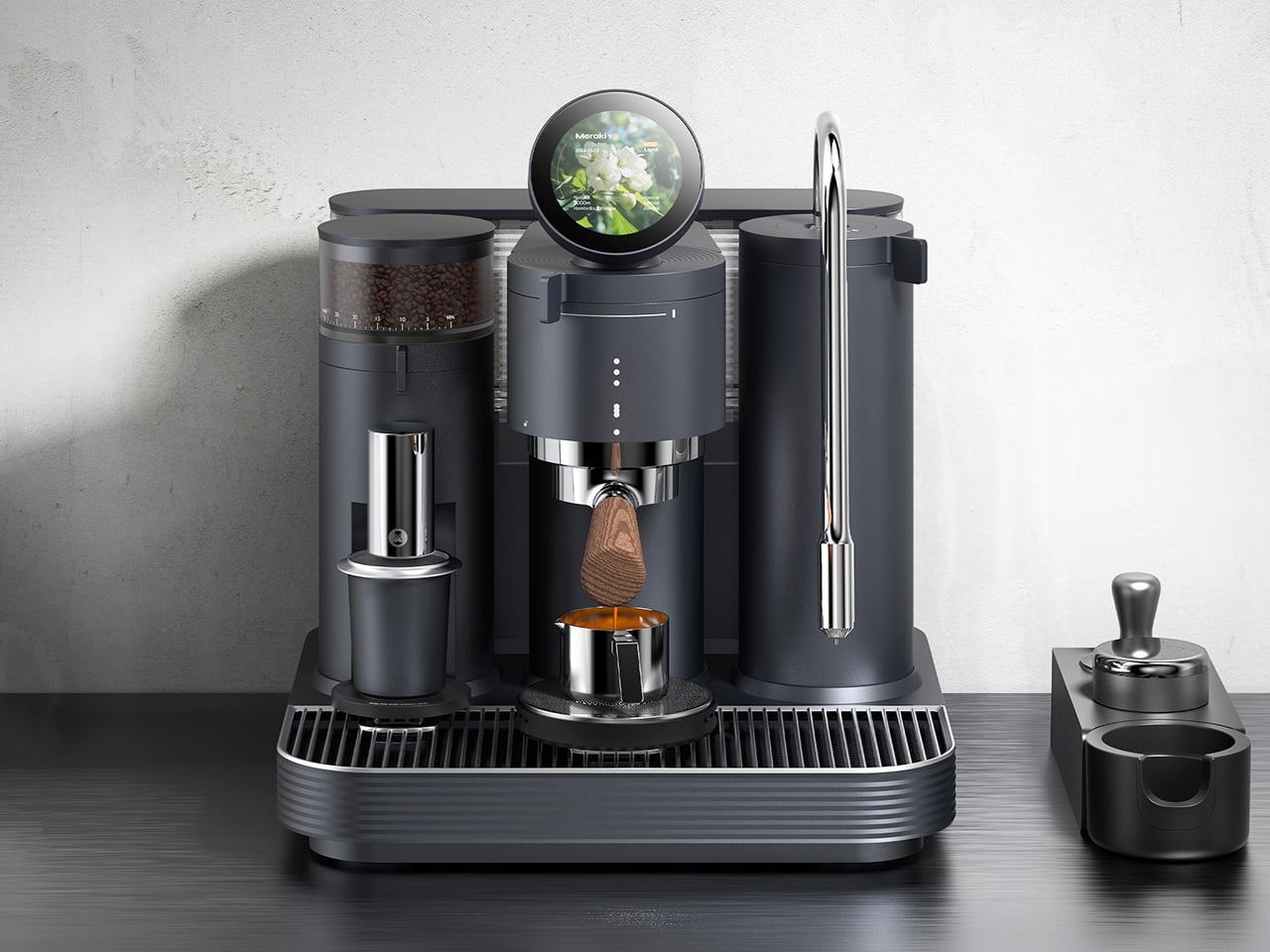
As a San Francisco-based industrial designer (with a second office in Lisbon), Yves Behar has developed a particular knack for creating products that reflect the technological optimism of Silicon Valley. From the that reimagines TV sets as artworks when not in use to the (a successor of sorts to the August smart lock, which also pioneered), Behar has no shortage of what he calls “category-defining firsts” under his belt. On many of his projects, Behar’s role extends beyond just industrial design to also address aspects like branding and user experience — a holistic philosophy that informs his design studio’s name, Fuseproject. Recently, Fuseproject has been an early voice in conversations about integrating A.I. into industrial design, building the technology into two robots — and — that are designed to be companions for kids and seniors company, respectively.

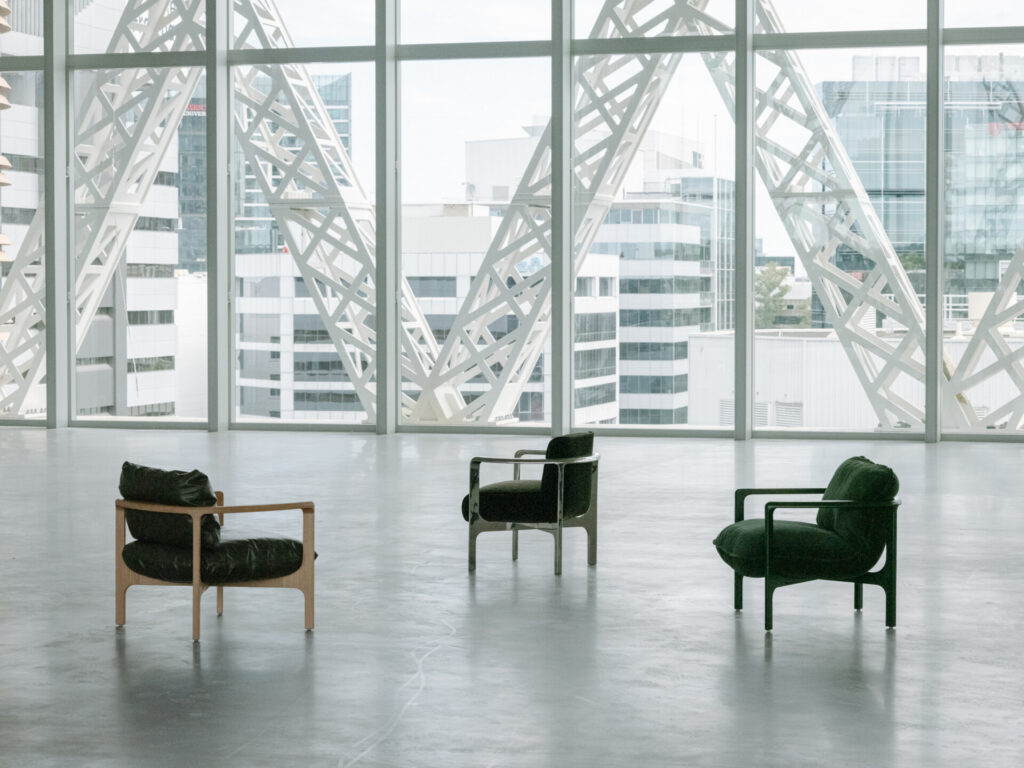
But Behar is by no means a tech bro. In conversation, he is less of an A.I. evangelist than you might expect, praising its power in some contexts but remaining mindful of its implications in others. Social media’s impact on kids worries him. And his latest design is refreshingly analogue: a seating system, Peaks, for that is essentially a giant set of upholstered triangular building blocks. The name, Peaks, harkens back to Behar’s upbringing in the Swiss mountains. But the design has another connection to Behar’s childhood. Growing up, he had a strong instinct to build things by hand. The playful modules of Peaks — a design originally developed for Behar’s own family — invite others to experience some of the same tactile joy.
After making a splash at during its official launch in January, Peaks was on view last week during as part of a pop-up highlighting workplace furnishing maker network of partner brands (which along with Moooi, also includes Viccarbe, Tom Dixon, Flos and Extremis.) This setup, dubbed Coalesse Co.Lab, demonstrated that Peaks can be just as relevant in an office setting as it can in a living room. In a nearby Fulton Market restaurant, we sat down with Behar to learn why Peaks is the new pinnacle of workspace social zones — and to hear about a few of the other summits that he is currently scaling.

When , you spoke about how you initially designed it for your family. Tell me about that backstory.
- Yves Behar:
-
During Covid, I really felt that the living room was kind of the place where we should all gather, but living rooms are not all that exciting for kids — unless you turn the TV on. And I also liked this notion of us all coming together in the same environment, rather than everyone being on different seats. I wanted something like the conversation pits of the 1970s. Peaks was what I came up with. As soon as I put it in the living room, it became the favourite room in the house, because it could be adapted for all these different purposes. My family had a few friends isolating with us, and if we were watching a show or a film, we could have 12 people all facing the same direction on theatre-style seats — or it could be a flat platform for lounging or wrestling and whatnot. The kids were changing it around every day, the adults were changing it around every day, and it became a real place to gather. I started making [Peaks sofas] for friends as well, and after I made five or six, I realized I needed to talk to somebody about putting it into production. I showed it to Marcel [Wanders, Moooi’s co-founder], who said “This is weird and different, but we wouldn’t be Moooi if we didn’t try things that are unique.” So we did.

Peaks started off in the living room, but now you’re presenting it as office furniture in Coalesse’s Co.Lab pop-up during Fulton Market DesignDays. What role do you see Peaks playing in a workplace setting?
-
Because it is modular, you can assemble it in the office in so many different configurations — it can be one large seat, or a group lounge area, or have many seats all facing forward for a presentation. I like my work to be used in ways that I didn’t expect, and this is a blank canvas. It may have been something that I designed for a specific purpose, but it also has the flexibility for people to use it in so many other applications.
You were talking earlier about family living rooms only feeling like a destination if there’s a screen on. Both at home and at work, everyone is spending so much of their time in front of screens. What is the benefit of something tactile like this that encourages hands-on interaction?
-
The playfulness creates opportunities for more people to convene in close proximity. In the office, moments for people to come together are important, because social contact helps us learn from one another and progress. Offices have conference rooms, but they’re not really a social environment — often, you have to reserve them in advance, and meetings feel very formal. If you put these types of more casual, engaging meeting spots in an office, then people have easy opportunities to have a quick, fun catch-up as part of their regular workflow. I use the metaphor of candy — if you place candy on a desk at arm’s length, people will eat a lot of candy. If you place it a foot away, nobody’s going to touch it.


Tell me about the name, Peaks.
-
In the beginning, I’d been calling it Triangle couch, because that’s what it’s made of. Marcel had the idea to call it Toblerone, connecting it to my Swiss upbringing, but we didn’t think Toblerone would let us. So I thought about it for a week and came back with Peaks. For the marketing, Moooi did a beautiful of it in the Swiss mountains, which is really cool.
Growing up in Switzerland, did you have an early sense that you wanted to become a designer?
-
As a kid, I used to build stuff all the time. At first, I would make things in my bedroom, but that would mess the room up. So my parents gave me a workbench in the basement — a big wood workbench with a couple vicegrips and a few tools — and I started building things down there. It was just a damp, dark, scary basement, but I loved going down there and making stuff. I was pretty young when I decided to be a designer — maybe 14 — which gave me a head start.
You’re now based in San Francisco. Silicon Valley is an especially exciting place when it comes to office campuses. What have you seen underway in workplace design there lately?
-
For the past eight years, I’ve been designing Canopy Coworking spaces. We have three coming up by the end of the year: a very large one in the Presidio in an incredible army base that’s been converted into residences and offices, one on the Embarcadero, which is a beautiful area by the water, and then another one opening at Stanford. That one is creating workspaces for students who have founded their own startups. Stanford wants them to remain on campus. I’m using Peaks in all three. For me, an office is a community-building opportunity — and the right furniture supports that.
Building off that startup space you’re working on at Stanford — you have had a lot of experience working with startups through Fuseproject. What is unique about the mindset of a startup that’s exciting from a design perspective?
-
In the mid-2000s, I changed our business model. Up until that point, I really felt like the best work was done when you work with companies for a long time. But then, suddenly there were all these startups that really couldn’t afford long-term partnerships with well-known professional design firms. I created a new model, which we have been using ever since, which is that 50 per cent of our work — or more — is now done in partnerships with startups. In the past 18 or so years, we have been partners — full partners, with equity — on about 100 startups. I love the experience because no matter what, the product will come out. A startup is not like a large corporation, which is often too afraid of risk to launch something different. Startups invent completely new things and in order to survive, they have to actually launch them. It’s been really diverse and fun, and allowed me to learn every day.
What is your own workspace like?
-
I go back and forth between two. We have one in San Francisco, which is in this pretty big warehouse that has tons of interstitial social spaces. And then for the past five years, we’ve had another office in the centre of Lisbon, in a beautiful traditional neighbourhood. We’re doing more of our European projects there, and also more of our prototyping for furniture work. Whether you’re working in stone or ceramics or cork or wood or textiles, there are so many craftspeople there who are excited to work with you. It has been amazing. So the office is a mix of prototypes and finished products. I like to put them together, because it demonstrates the fidelity of a prototype.

You mentioned earlier that Moooi had used A.I. to create some of the marketing images for Peaks. A.I.’s role in the workplace is a big conversation topic these days. You’ve done a lot of work harnessing the power of different technologies, including A.I., with tools like the and . What role is A.I. playing in your own workflow?
-
In my creative work, it is playing very little role. A.I. is very good at making things look like other things that have already existed, but they all fall within familiar categories. It’s not useful at all in the early creative process when you’re trying to develop a first-in-the-world idea. It is useful at the end if you want to create animations or quick renderings. And we do use A.I. within our products — we’ve probably designed more A.I.-based products and robots than any other design firm — but we do it all from a humanistic point of view. Elliq is a companion for the aging, and Moxie is a product made for kids on the spectrum. I think when you use this technology to support healthcare, mental health, education, it’s extremely compelling. I also think it’s extremely dangerous when you look at [the role it could play in] security and whatnot, but ultimately it’s a tool. I think it’s extremely powerful, and could be extremely dangerous, but could also be extremely positive if you use it in the right places. Humans just have a tremendous responsibility to not let Pandora out of the box.

What are you cautious about when it comes to technology?
-
When technology is used to support or educate humans, it’s tremendous. But when a technology company’s main motivation is pure profit, then we’re in trouble. Right now, the incentive for many companies is to get as much engagement as possible, because that’s what the stock price is measured on, but engagement is just another word for addiction. What we’ve done to youths and teenagers with phones and social media is really a crime. Hopefully, we’re waking up to this. A lot of different places are now setting up guard rails for teens. But social media is also something that has affected us in a tremendously negative way when it comes to politics and science.

Moving to another pursuit of yours — you are the head of design at Telo, which makes a compact EV with a big truck bed. What has you excited about that project?
-
Early production models are going to be on the market by the end of the year, with full production in two years. I love getting to rethink that whole category. In the past 10 years, EVs have been designed pretty much the same way that regular cars are designed, so the opportunities that EVs afford us in terms of efficiency, sizing and integration have not been fully realized. For me to take those opportunities and put them into a product that’s going to be affordable and practical for people in construction, for creatives, and for families on the weekend, has been a dream. Technically speaking — and in terms of regulatory processes — it’s been very complex, but I have great co-founders who have a lot of experience there. The exterior is pretty much done, and we’re finishing the last details on the interior now, rethinking the seats and their construction. We’re using awesome materials — a lot of sustainable materials. Working on the interior functionality has me very fired up, and learning a lot.

The Ferrari Luce has recently encountered for being too big a departure from the brand’s style. Is it easier with Telo to be launching a new car brand, rather than trying to introduce a design like you’ve come up with as a new model of Tacoma or F150 or something?
-
I used to do work with larger car companies — all of which is still in drawers somewhere — and I’ve experienced the lack of new thinking firsthand. You have models coming out every year with the same names and the same kind of look, which really prevents innovation to the human experience. But I understand that there are certain legacy brands where progression and evolution are slow, because the emotional values built into the brand are central. Recently, we designed a pen for Montblanc. It’s a digital pen, but it has the classic proportions and the same branding elements on there. In that case, it was important to keep some familiar codes in there. But generally, I like building new brands, because yes, you can imbue them with new qualities.
You were telling me earlier that your next stop after this is the Tribeca Film Festival, to watch , which you’re a . How has your relationship to the festival shaped your perspective on design?
-
For me, Burning Man is a an act of creation. The city has to be created, your camp has to be built, 100 or so different sculptures and pieces of art get built, art cars have to be designed — all in a very difficult environment where there are no resources. It’s a creative, community-built experience. And nobody gets paid — the best DJs in the world come and don’t get paid, and there are no big sponsor brands. That’s why I love it, and what makes it completely different from going to a concert or party, which is just a consumption event. This is the only festival that’s a nonprofit that hasn’t been bought by private equity, and it’s participatory. It’s a really important part of my year where I get to express my creativity in new ways. Last year, I was driving around using a recycled Telo chassis from the very first prototype we made. Really, it’s a week long utopia for creatives. And at the end, there’s not a speck left. Entire teams of volunteers clean up the playa — the desert — speck by speck for six to eight weeks after the festival. It’s inspiring, and I think it’s important that it exists and continues to flourish. So I hope the documentary captures that.
The post appeared first on .
Related Posts