Jim Otar is a retired engineer-turned-financial-planner who has written many books and articles about retirement income. I recently found an old bookmark and reread his article from . One core principle of his retirement advice that you don’t plan using averages:
The averages don’t cut it. For proper retirement planning, you must base your retirement solutions and strategies on adverse outcomes and not average outcomes.
For example, you don’t plan for average life expectancy. You plan for reaching age 95 for both you and your spouse/partner if applicable.
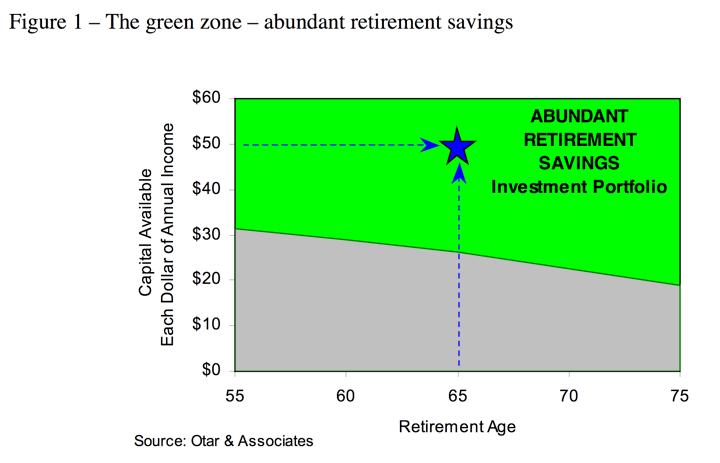
Green Zone: You have enough money that you can simply live off a balanced portfolio of stocks and bonds, even if returns are on the unlucky side of history and much lower than average. Here are the numbers for his calculated sustainable withdrawal rate until age 95:
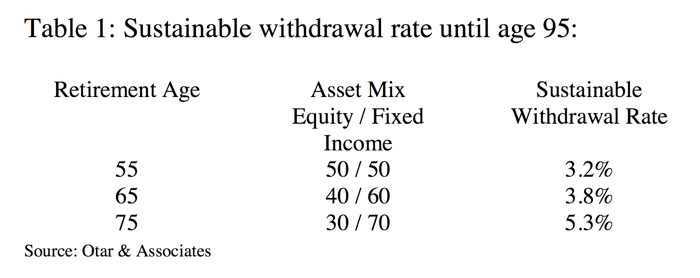
For example, if you are 65 years old and need $40,000 of annual income from your portfolio (above Social Security and other income sources), then you would need a portfolio balance of $40,000 divided by 3.8% = $1,052,631. (Alternatively, multiply $40,000 by 26.3.) If you have more than this, you are in the green zone. You’ll have enough money even after a market run that is bad historically, and you’ll probably end up leaving a decent estate or be able to spend more later on.
Red Zone: You need guaranteed income. You don’t have enough to live off of a portfolio of stocks without a decent chance of running completely out of money. The most prudent advice is to buy annuities that will provide a guaranteed level of income and stretch your limited assets for the rest of your lifetime, no matter how long that is.
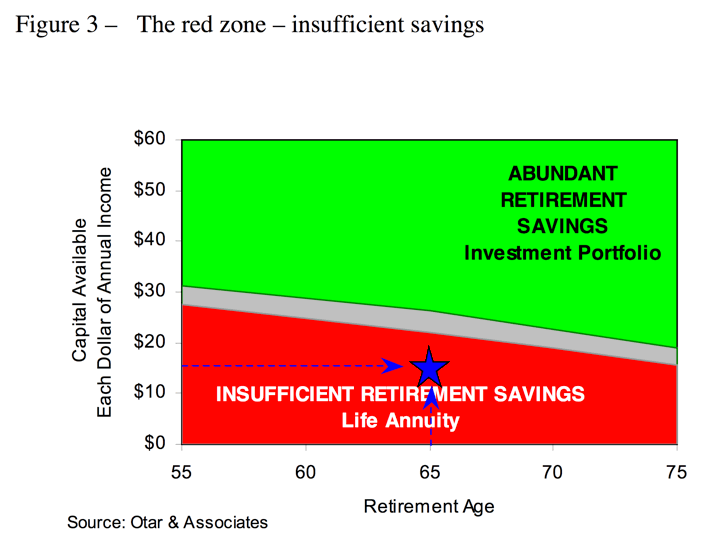
The advice is then to use your money to buy a single premium immediate life annuity with payments that are indexed to inflation (CPI). At the time of writing, such an inflation-indexed SPIA would pay more that the sustainable rate above. The effective “safe withdrawal rate” for the same 65-year-old above would be 4.5% to 4.9%. Unfortunately, this article was written back in 2007 and as of 2022 there are zero insurance companies that offer inflation-indexed immediate annuities.
However, the same overall concept still applies. The Red Zone means you need to take critical action. You should see how much guaranteed lifetime income you can receive from a single premium immediate annuity (SPIA), perhaps with an escalation rider that increases your payout 1%-3% every year. You will need to consider reducing expenses somehow (downsize home, relocate to lower cost-of-living area). You may need to find additional income (keep working, rent out property). You might need to do all three.
Grey Zone used to mean that you were between the 3.8% withdrawal rate of the Green Zone and the 4.5% withdrawal rate of the Red Zone. Today, I assume it simply means you are close to green, but not quite. You should take some of those Red Zone actions listed above.
I found the Green/Grey/Red Zone concept to be an interesting retirement planning framework to consider. If you don’t have enough, you shouldn’t just wing it with stocks and hope for the best. SPIAs can help you stretch your money for a more secure retirement. I believe that SPIAs aren’t discussed enough in personal finance, and if there were more demand, perhaps the competition would create better and higher-yielding SPIA products. The problem is that non-transparent products like indexed annuities that promise things like “market-linked returns with no downside risk” are both better sellers and offer higher commissions to most insurance salespeople.
“The editorial content here is not provided by any of the companies mentioned, and has not been reviewed, approved or otherwise endorsed by any of these entities. Opinions expressed here are the author’s alone. This email may contain links through which we are compensated when you click on or are approved for offers.”
from .
Copyright © 2004-2021 MyMoneyBlog.com. All Rights Reserved. Do not re-syndicate without permission.
Related Posts